

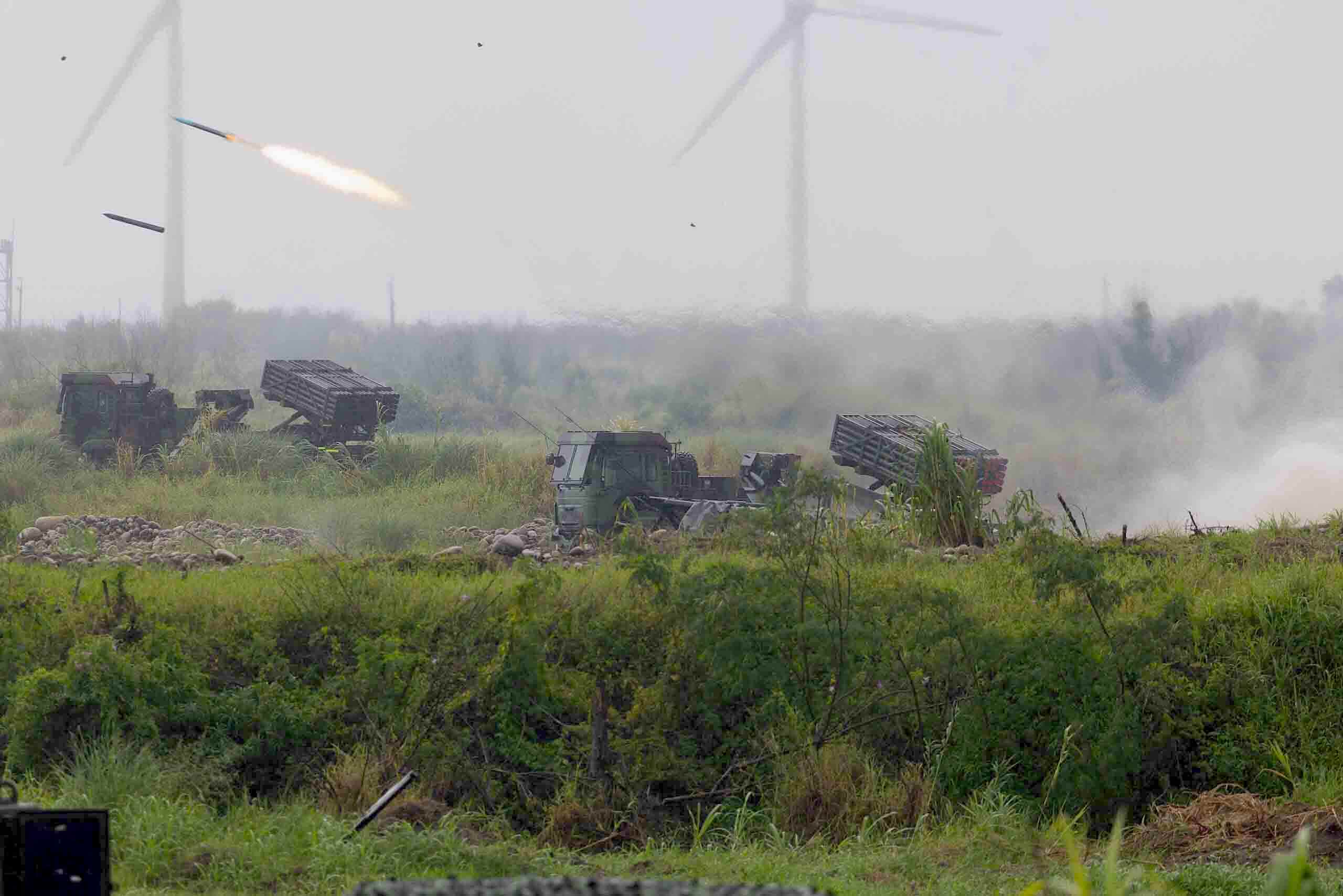
【軍傳媒/國內軍事新聞】陸軍第十軍團9日於臺中大甲溪出海口南北岸周邊,實施「115年重砲射擊暨新式武器換裝驗證」射擊訓練,整合58砲指部及586旅等部隊,動員雷霆2000多管火箭系統、M109A2自走砲、M110A2自走砲、155公厘榴彈砲、120迫擊砲及拖式飛彈車等多項武器,總計6類、372發實彈,在約20公里正面、8處陣地分散同步展開。這不僅是一次火力展示,更是以作戰地境為背景,驗證聯合火力指揮、異地分區射擊、戰場機動部署與擊殺鏈運作成效的重要訓練。
本次射擊以敵軍兩棲兵力企圖進犯中部地區為想定,9日上午8時後正式展開。首先由中科院自行研發的雷霆2000多管火箭系統,對模擬於白沙屯海灘登陸之敵實施區域打擊,總共三台車、每台發射60發Mk-15火箭彈共180發;後續再由M109A2,分成三個陣地7+7+6台,總共是20門火砲60發砲彈,對甲南海灘方向之敵軍實施要域火殲,藉由連續壓制與火力覆蓋,遲滯並削弱敵軍登陸後戰力。當敵軍模擬突入後,拖式飛彈車與120迫擊砲則接續投入,執行近距離反裝甲與持續壓制任務,完整呈現從遠距區域打擊、縱深火力削弱,到近距離反擊的多層次防衛火力運用。

其中雷霆2000多管火箭系統時隔多年後,再度於實施實彈射擊。58砲指部火箭連連長廖能政 少校受訪時表示,部隊在任務過程中面對天候與環境影響,但仍順利完成射擊任務,這對連隊而言不只是驗證裝備性能,也是檢驗官兵平時訓練的重要機會。
與過去重砲射擊不同的是,本次訓練更強調「實戰化」與臨戰部署節奏。過往部隊通常會提前一週進入陣地,完成各項射擊準備;然而這次改採前一日才進入作戰地境,進行陣地整備與射擊準備,使部隊必須在更短時間內完成部署、架設、檢查與通聯。受訪幹部指出,這樣的安排更接近戰時條件,也大幅增加官兵作業壓力,對火砲開設、車輛定位、彈藥整備與指揮管制都是實際考驗。
現地環境同樣增加訓練難度。大甲溪出海口周邊屬沙灘與軟質地面,與部隊平時多數訓練場域的硬質地形不同。火箭車與火砲在軟地面開設時,必須增加軟地座板,以確保射擊穩定度。受訪官兵說明,射擊前必須先將車體調整至水平狀態,但因泥土與沙地容易下陷,官兵需使用工具與鏟具重新整平地面,再完成座板設置與車體穩定作業。雖然準備時間相對緊迫,但部隊仍在時限內完成任務,顯示基層官兵對裝備操作與陣地開設程序已有相當熟練度。

586旅砲兵營砲一連連長林俊成上尉則表示,這是他擔任連長後第二次參與重砲射擊,能看到官兵在雨天與不利條件下仍熟練操作火砲並完成射擊任務,對連隊而言是重要經驗。他指出,雨天對觀測任務確實造成較大負擔,但部隊平時即針對雨天備案與射擊程序進行訓練,因此能依照既定程序完成任務。通聯方面,本次也運用新式ATAK系統輔助通聯與資訊整合,反映陸軍火力部隊正逐步導入數位化指揮與戰場資訊共享工具。
針對射擊過程中外界關注的一枚雷霆2000彈藥異常情形,58砲指部相關幹部說明,該枚彈藥並非未離架,而是已順利自彈箱發射並離開發射車,但疑似在第二段點火階段出現異常,將交由中科院人員進一步分析研判。據現場雷觀機觀測,該彈離開發射車約400公尺,仍在安全範圍內。幹部強調,不發火與彈藥異常處置本就是平時訓練與射擊前驗證的重要項目,部隊在射擊前均會接受砲訓部教官檢整與簽證,相關故障排除程序也已納入日常訓練。
本次演習並非單純展示重砲火力,而是透過作戰地境、分散部署、短時準備、數位通聯與多兵種火力接續,模擬中部沿海防衛作戰的實際場景。雷霆2000負責遠距面殺傷與登陸灘頭區域壓制,自走砲與榴彈砲承擔要域火殲,迫擊砲與拖式飛彈則補足近距離壓制與反裝甲任務。這樣的配置,正是面對兩棲登陸威脅時,陸軍地面火力部隊必須具備的分層打擊能力,而天候的不佳正好驗證裝備的可靠度及在惡劣天氣的操作能力,畢竟戰爭是不分時間及天候。
十軍團表示,藉由此次重砲與新式武器射擊任務於作戰地境內實施,可有效提升實戰化訓練成效,使官兵體認「處處皆戰場,時時做訓練」的要求,並強化部隊指揮管制與聯合火力運用能力。隨著下半年仍將持續實施戰術射擊,陸軍火力部隊也將進一步驗證「新訓練、新思維、新裝備、新科技」在防衛作戰中的實際效益。

Heavy Artillery Live-Fire Drill Verifies Joint Fires as Thunderbolt-2000 Returns to Live Firing After Years
[Military Media / Domestic Military News] The Republic of China Army’s 10th Corps conducted its “2026 Heavy Artillery Live-Fire Drill and New Weapon Replacement Verification” on June 9 around the northern and southern banks near the mouth of the Dajia River in Taichung. The exercise integrated units including the 58th Artillery Command and the 586th Brigade, mobilizing multiple weapon systems such as the Thunderbolt-2000 multiple launch rocket system, M109A2 self-propelled howitzers, M110A2 self-propelled howitzers, 155mm howitzers, 120mm mortars, and TOW missile vehicles.
A total of 372 live rounds across six categories were fired from eight dispersed firing positions across an approximately 20-kilometer frontage. This was not merely a firepower demonstration, but an important training event set against an operational environment to verify the effectiveness of joint fire command, geographically dispersed firing, battlefield maneuver deployment, and kill-chain operations.
The live-fire drill was based on a scenario in which enemy amphibious forces attempted to invade central Taiwan. The exercise officially began after 8 a.m. First, the Thunderbolt-2000 multiple launch rocket system, developed domestically by the National Chung-Shan Institute of Science and Technology, carried out area strikes against simulated enemy forces landing at Baishatun Beach. Three launch vehicles each fired 60 Mk-15 rockets, for a total of 180 rockets.
The mission was then followed by M109A2 self-propelled howitzers deployed across three firing positions, with seven, seven, and six guns respectively. A total of 20 artillery pieces fired 60 rounds against enemy forces in the Jianan Beach direction, carrying out key-area fire destruction through continuous suppression and fire coverage to delay and weaken enemy combat power after landing. After the simulated enemy force penetrated inland, TOW missile vehicles and 120mm mortars were committed in sequence to conduct close-range anti-armor and sustained suppression missions, presenting a complete layered defensive firepower concept from long-range area strikes and depth fire attrition to close-range counterattacks.
Among the systems involved, the Thunderbolt-2000 multiple launch rocket system conducted live firing for the first time in many years. Major Liao Neng-cheng, commander of the rocket company under the 58th Artillery Command, said in an interview that the unit faced weather and environmental challenges during the mission, but still successfully completed the firing task. For the company, this was not only a verification of equipment performance, but also an important opportunity to test the training standards of officers and soldiers.
Unlike previous heavy artillery live-fire drills, this training placed greater emphasis on realism and the tempo of combat deployment. In the past, units would usually enter their firing positions about one week in advance to complete various preparations. This time, however, troops entered the operational area only one day before the drill to conduct position preparation and firing readiness work. This required units to complete deployment, setup, inspections, and communications within a much shorter timeframe.
Interviewed officers pointed out that this arrangement was closer to wartime conditions and significantly increased the operational pressure on personnel. It served as a practical test of artillery emplacement, vehicle positioning, ammunition preparation, and command and control.
The local terrain also increased the difficulty of the training. The area near the mouth of the Dajia River consists largely of beaches and soft ground, unlike the hard-surface terrain found in most regular training areas. When rocket vehicles and artillery pieces are deployed on soft ground, additional base plates must be installed to ensure firing stability. According to interviewed personnel, before firing, the vehicle body must first be adjusted to a level position. However, because soil and sand can easily sink, troops must use tools and shovels to re-level the ground before setting up the base plates and stabilizing the vehicle.
Although preparation time was relatively tight, the units still completed their tasks within the required timeframe, demonstrating that frontline personnel were already highly proficient in equipment operation and firing position setup procedures.
Captain Lin Jun-cheng, commander of the 1st Company, Artillery Battalion, 586th Brigade, said this was his second time participating in a heavy artillery live-fire drill since becoming a company commander. He noted that seeing his troops operate the artillery skillfully and complete the firing mission under rainy and unfavorable conditions was an important experience for the company.
Lin said that rainy weather did place a heavier burden on observation missions, but the unit regularly trains for rainy-weather contingency plans and firing procedures, allowing it to complete the mission according to established procedures. In terms of communications, the exercise also used the newer ATAK system to support communications and information integration, reflecting the Army’s gradual introduction of digital command and battlefield information-sharing tools into its firepower units.
Regarding public attention over an abnormality involving one Thunderbolt-2000 munition during the firing process, officers from the 58th Artillery Command explained that the munition did not fail to leave the launcher. Rather, it was successfully launched from the pod and left the launch vehicle, but a suspected abnormality occurred during the second-stage ignition phase. Further analysis and assessment will be carried out by personnel from the National Chung-Shan Institute of Science and Technology.
According to observations from the on-site radar observation aircraft, the munition traveled approximately 400 meters after leaving the launch vehicle and remained within the safety area. Officers emphasized that misfire and munition-abnormality procedures are already important parts of routine training and pre-firing verification. Before live firing, the units undergo inspection and certification by instructors from the artillery training command, and related troubleshooting procedures have also been incorporated into daily training.
This exercise was not simply a display of heavy artillery firepower. Through an operational environment, dispersed deployment, short-notice preparation, digital communications, and sequential fires from multiple arms, it simulated a realistic central Taiwan coastal defense scenario.
The Thunderbolt-2000 was responsible for long-range area effects and suppression of the landing beachhead. Self-propelled howitzers and towed howitzers carried out key-area fire destruction, while mortars and TOW missiles filled the close-range suppression and anti-armor roles. Such a configuration represents the layered strike capability that the Army’s ground firepower units must possess when facing an amphibious landing threat.
The poor weather conditions also provided an opportunity to verify equipment reliability and operational capability under harsh weather. After all, war does not distinguish between time or weather.
The 10th Corps stated that conducting this heavy artillery and new weapon live-fire mission within an operational environment can effectively enhance the results of realistic training. It also helps officers and soldiers understand the requirement that “everywhere is a battlefield, and training must take place at all times,” while strengthening command and control as well as joint firepower employment.
As tactical live-fire training continues in the second half of the year, the Army’s firepower units will further verify the practical effectiveness of “new training, new thinking, new equipment, and new technology” in defensive operations.