

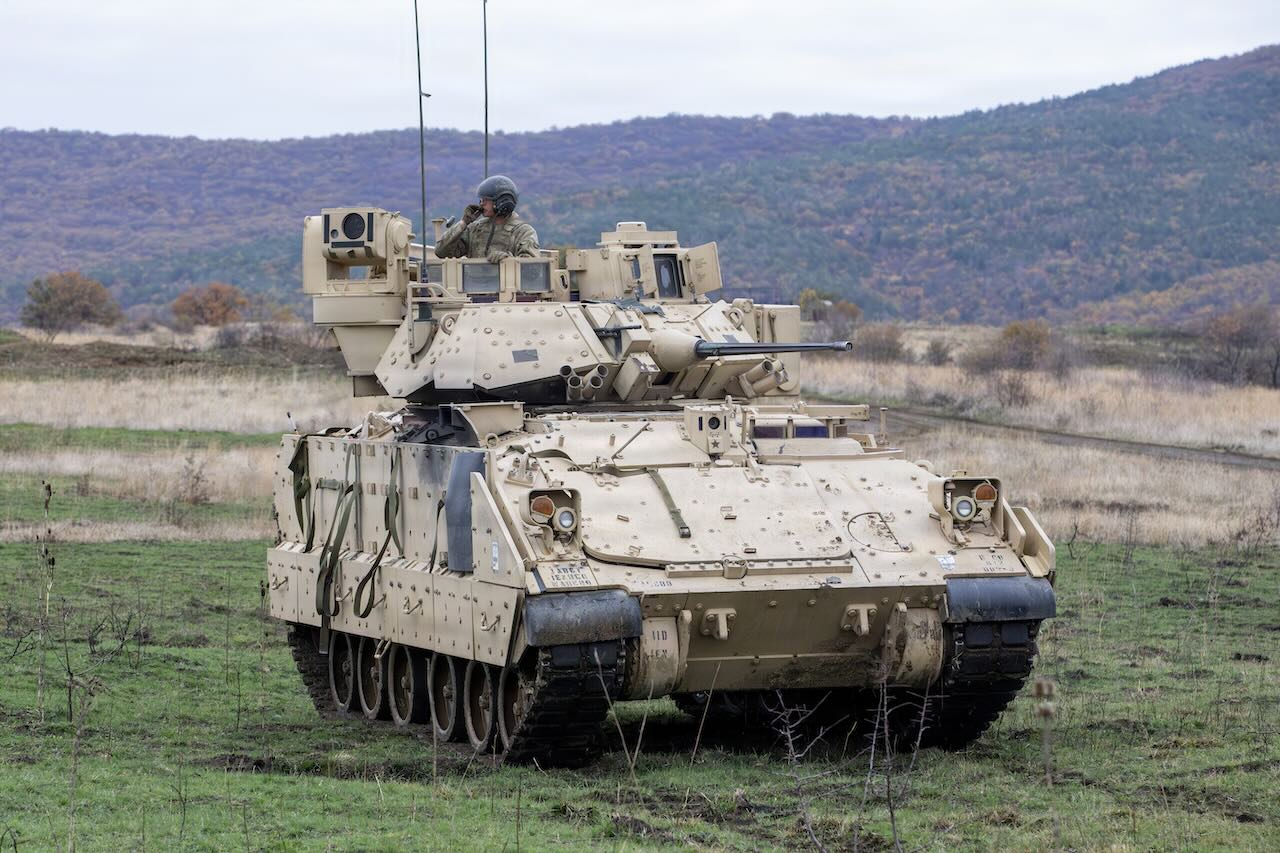
【軍傳媒/軍事科技】烏克蘭接收美製M2 Bradley(布雷德利)步兵戰鬥車後,對其在烏克蘭戰場上的表現讚不絕口,美製 M2 Bradley(布雷德利)步兵戰鬥車的好名聲並不是靠光鮮的規格表堆出來的,而是靠實際的戰鬥能力,以及保護成員存活的生存性,使得成員能活下來述說經歷的故事。最被世人所知的是2024年七月2輛M2 Bradley(布雷德利)步兵戰鬥車近距離遭遇俄羅斯戰車,成員發揮車輛機動性,以及人員的高戰鬥素質,在短暫交火中成功摧毀戰車。
俄烏戰場上的經驗顯示,M2 Bradley(布雷德利)步兵戰鬥車它能在地雷、砲擊、無人機(含 FPV)混合威脅下,讓乘員「活著下車」的機率顯著提高,之前烏克蘭夏季大反攻時西方援助的戰甲車因錯誤的使用損失不少,顯示沒有一種裝甲單位是無堅不摧的;俄烏戰場也同時殘酷的證明,傳統步戰車的火力、感測與防護,隨著步兵反戰車武器的射程增加,以及漫天飛舞的自殺無人機面前,都面臨到一面倒挨打的局面。烏軍士兵曾對外媒直言:如果當時坐的是蘇式裝甲車,受到第一擊後大概都瞬間陣亡了,這句話既是對 Bradley 生存性的肯定,也是對下一代步戰車需求的殘酷注解。
美國陸軍的新世代 XM30(原 Optionally Manned Fighting Vehicle/OMFV)正是在俄烏戰場新經驗的背景下被重新更動設計,它不只是要換掉已經服役40年的 M2 Bradley(布雷德利)步兵戰鬥車,更要能符合未來戰場的需求,其中主武器從 25公釐鏈砲一下跨越到50公釐(XM913)口徑,這也使得XM30 成為近年歐洲主流30/35/40公釐口徑機砲之外的大升級。

烏克蘭戰場經驗影響設計的三個方向
- 必須能有效攻擊掩體後目標:城鎮建築、森林遮蔽、壕溝防禦把「看得見」與「打得到」拆成兩件事,即便如烏克蘭戰場已經有許多地方是開闊視野的平原與丘陵,但仍有許多高密度遮蔽環境,讓步兵與反裝甲小組能大量以牆角、土堤、建物殘骸、林線等作掩護遠距離攻擊裝甲部隊,更不要說是躲在暗處操作無人機的獵殺小組。這使得M2 Bradley(布雷德利)步兵戰鬥車以直射、點殺傷為主的25公釐機砲無法有效勝任,必須仰賴間接火力、側翼繞行才能提高殺傷效率。25公釐機砲威力不足的缺點讓XM30在設計之初直上50公釐彈藥。
- 無人機反制:由於第一人稱自殺無人機(FPV)讓接觸線前後大範圍區域變得高度致命,這一範圍內的後送、補給、短距離機動都在無人機監視與攻擊下變得困難;甚至為了對付光纖導引或抗干擾的新型FPV,烏軍不得不發展多層手段(電子作戰、反無人機攔截、低技術的霰彈槍等)。根據戰場的經驗,只要裝甲車輛暴露幾分鐘,通常就會被無人機盯上、接下來的就是被連續攻擊。無人機把戰場節奏拉到分鐘甚至以秒計算,迫使裝甲載具必須更快發現、更快反應、更快脫離威脅才能生存。
- 生存性:現代步戰車的價值,越來越常被用「乘員存活率」來衡量。俄製裝甲載具在俄烏戰場上的殉爆率讓成員死傷慘重,烏克蘭人力資源本就稀缺,M2 Bradley(布雷德利)步兵戰鬥車在烏克蘭軍隊能獲得好口碑,主要就是在遭受是在多重攻擊下仍能保住成員性命、同時讓乘員撤離。外媒引用烏軍乘員的描述,將其歸因於車體防護、內部布局、以及一定程度的防護冗餘(哪怕車輛失能)。然而,無人機與攻頂武器的擴散,也讓裝甲單位單靠被動裝甲無法獲得足夠的防護,雖然疊甲讓裝甲單位更耐打,但總有被打穿的時候;因此「降低被發現/被鎖定、提高硬殺/軟殺防護、縮短暴露時間」開始成為裝甲單位提高生存性的課題。

XM30 的設計改動
美國國會研究處(CRS)對 XM30 的描述相當直接:它是用來在裝甲旅戰鬥聯隊框架內取代M2 Bradley(布雷德利)步兵戰鬥車的「可選擇有人/無人平台」,目標是在未來與同級對手交戰時,提供部隊取得致命性優勢。
把乘員從「最危險的位置」移開
OMFV/XM30 一直強調無人化砲塔與選擇性人力概念,並在早期構想中提到縮減車組、增加自動化的方向。烏克蘭戰場經驗證明砲塔區是最容易被命中的區域之一,砲塔內若無成員,越能降低成員傷亡的機率。
多種感測器與整合射控不再是加裝選項,而是車的核心能力
無人機讓「先看到、先打到」的重要性更形凸顯。50公釐可編程彈藥(例如空炸)需要射控電腦完成測距、編程與發射流程,這意味XM30必須把更高等級的光電/測距/射控整合為常態能力,而不是靠乘員肉眼、靠經驗修正彈著。
生存性從被動防護擴展到「反無人機/反飛彈」的主動防護
CRS 與相關報導一再點出,XM30的設計重點之一是生存性與改良空間,主動防護系統(APS)與反無人機防護已經是必須。烏克蘭戰場上對抗FPV、光纖 FPV的手段演進,也在提醒各國,若今天設計不把反無人機納入車體方案,明天就會被迫用焊接網籠、臨時電子戰等方式補救,這種威脅是未來戰場上必有的。

台灣的雲豹
反觀台灣,成為陸軍步兵戰鬥車的主力「雲豹裝甲車」,火力上的30公釐機砲只能勉強跟得上世界潮流,考量到台灣的威脅,只能說若搭配合適的火控與彈藥則夠用,但前提就是要有合適的火控與彈藥。台灣的雲豹射控無法鎖定小型無人機、也無法生產可編程的彈藥、沒有主動防護系統、被動防護因動力不足無法增加,當裝備設計明顯與國外一線裝備有落差,要如何提供足夠的安全感給要在前線拼殺的國軍弟兄,設計、規劃、採購、生產者若與使用者脫節,則俄羅斯裝甲裝備的殷鑑不遠。
From M2 to XM30,The New Design for Next-Generation Infantry Fighting Vehicle
After Ukraine received U.S.-made M2 Bradley infantry fighting vehicles (IFVs), praise for their battlefield performance quickly followed. The strong reputation of the Bradley was not built on glossy specification sheets, but on real combat capability and, above all, survivability—the ability to keep crews alive so they can tell their stories afterward.
One of the most widely cited incidents occurred in July 2024, when two M2 Bradleys encountered Russian tanks at close range. By exploiting the vehicle’s mobility and the crew’s high level of training, the Bradleys successfully destroyed the enemy tanks in a brief engagement.
Experience from the Russia–Ukraine war shows that the M2 Bradley significantly increases the probability that its crew can “dismount alive” under mixed threats such as mines, artillery fire, and drones—including FPV loitering munitions. During Ukraine’s earlier summer counteroffensive, many Western-supplied armored vehicles were lost due to improper employment, underscoring the fact that no armored platform is invulnerable. At the same time, the war has brutally demonstrated that traditional IFVs—with legacy firepower, sensors, and protection—are increasingly overmatched as infantry anti-armor weapons gain range and suicide drones saturate the battlefield.
Ukrainian soldiers have told foreign media bluntly that had they been riding in Soviet-designed armored vehicles, the first hit would likely have killed them instantly. This statement is both a powerful endorsement of the Bradley’s survivability and a stark annotation of the operational requirements facing the next generation of IFVs.
Why the XM30 Was Reconceived
Against this backdrop, the U.S. Army’s next-generation XM30—originally known as the Optionally Manned Fighting Vehicle (OMFV)—was significantly revised. The program is not merely intended to replace the 40-year-old M2 Bradley, but to meet the demands of future high-intensity warfare. One of the most striking changes is the jump in main armament from a 25 mm chain gun to a 50 mm cannon (XM913), a major step beyond the 30/35/40 mm calibers that dominate recent European IFV designs.
Three Key Lessons from Ukraine
1. Engaging targets behind cover
Urban terrain, forests, and trench systems separate “what can be seen” from “what can be hit.” Even though large parts of the Ukrainian battlefield consist of open plains and rolling hills, dense cover remains common. Infantry and anti-armor teams routinely exploit walls, earthworks, building debris, and tree lines to engage armored vehicles from long range. Drone operators, often hidden from view, pose an additional lethal threat.
Under such conditions, the Bradley’s 25 mm gun—optimized for direct fire and point targets—has limited effectiveness. Successful engagements often require indirect fires or flanking maneuvers to achieve acceptable kill probability. This shortfall in destructive power was a key reason the XM30 program opted from the outset for a 50 mm weapon.
2. Countering drones
FPV suicide drones have turned wide swaths of terrain along and behind the contact line into highly lethal zones. Casualty evacuation, resupply, and even short-range maneuver now take place under constant aerial surveillance and attack. To counter fiber-optic or jam-resistant FPVs, Ukrainian forces have had to adopt layered defenses, ranging from electronic warfare and interceptor drones to low-tech solutions such as shotguns.
Battlefield experience shows that once an armored vehicle is exposed for more than a few minutes, it is likely to be spotted by drones and subjected to repeated strikes. Drones have compressed the tempo of combat to minutes—or even seconds—forcing armored platforms to detect threats faster, react faster, and break contact faster if they are to survive.
3. Survivability as the primary metric
Increasingly, the value of a modern IFV is measured in crew survivability. Russian armored vehicles have suffered catastrophic kill rates in Ukraine, often resulting in severe crew casualties. For Ukraine, where manpower is already scarce, this has been especially costly.
The Bradley’s positive reputation within Ukrainian units stems largely from its ability to protect crews under multiple attacks and still allow evacuation. According to accounts cited by foreign media, this is attributed to a combination of vehicle armor, internal layout, and a degree of built-in redundancy—even when the vehicle is rendered combat-ineffective.
However, the proliferation of drones and top-attack weapons means that passive armor alone is no longer sufficient. While additional armor can improve resilience, penetration is ultimately inevitable. As a result, reducing detectability and lock-on probability, improving hard-kill and soft-kill defenses, and minimizing exposure time have become central to survivability.
Key Design Shifts in the XM30
The U.S. Congressional Research Service describes the XM30 succinctly: an optionally manned platform intended to replace the M2 Bradley within armored brigade combat teams, providing decisive lethality against peer adversaries in future conflicts.
Removing crews from the most dangerous locations
The OMFV/XM30 concept emphasizes an unmanned turret and optional manning from the outset, with fewer crew members and higher automation. Ukrainian battlefield experience has shown that turrets are among the most frequently hit areas of armored vehicles. Eliminating crew presence in the turret significantly reduces the risk of casualties.
Sensors and integrated fire control as core capabilities
In a drone-saturated environment, “seeing first and shooting first” is more critical than ever. Programmable 50 mm ammunition—such as airburst rounds—requires integrated fire-control systems capable of rangefinding, fuze programming, and precise firing. This demands that advanced electro-optical sensors and fire-control integration be standard features, rather than optional add-ons dependent on crew eyesight and experience.
From passive armor to active counter-drone and missile defense
Both CRS assessments and related reporting emphasize survivability and growth potential as central XM30 design goals. Active protection systems (APS) and counter-drone measures are no longer optional. The rapid evolution of counter-FPV tactics in Ukraine illustrates a clear lesson: if counter-drone protection is not built into the platform from the start, forces will be forced to improvise later with welded cages and ad-hoc electronic warfare solutions. This threat is not temporary—it is a defining feature of future battlefields.
Taiwan’s Yunbao in Comparison
By contrast, Taiwan’s primary infantry fighting platform, the Yunbao armored vehicle, lags behind leading international designs. Its 30 mm cannon only marginally keeps pace with global trends. Against Taiwan’s threat environment, the firepower could be considered adequate only if paired with appropriate fire-control systems and ammunition—and that caveat is critical.
The Yunbao currently lacks the ability to lock onto small drones, cannot employ programmable ammunition, has no active protection system, and cannot significantly increase passive armor due to power and mobility constraints. When a platform’s design visibly trails frontline international systems, the question becomes how it can provide sufficient confidence to soldiers expected to fight on the front line. If designers, planners, procurement authorities, and manufacturers are disconnected from end users, the hard lessons written in the wreckage of Russian armored forces in Ukraine are a warning that should not be ignored.