

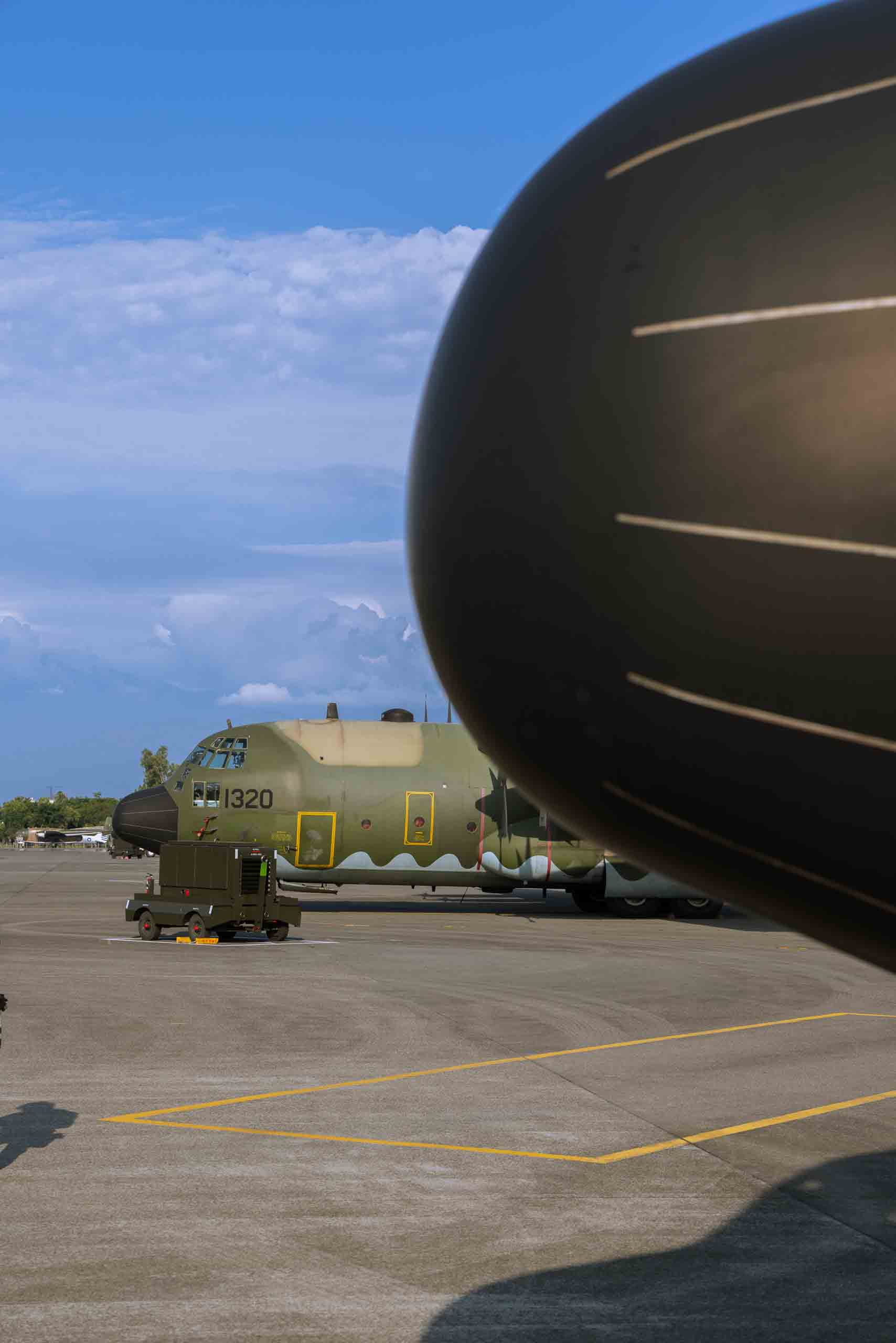
【軍傳媒/從軍我驕傲】空軍第六聯隊負責駕駛C-130H運輸機的少校飛行官黃雅妃少校,平時負責C-130H的飛行任務,包括人員物資的本島及外離島運輸,但一接到特殊命令,就會準備執行相關的任務。
執行人工增雨任務事前準備與一般任務稍有不同,在執行人工增雨過程中,由於飛行高度較高且需要打開艙門,因此機艙內不會加壓,飛行全程中所有機組人員均要使用氧氣面罩供氧,因此在飛行前半小時全體組員就要開始排氮程序。而因為飛行過程中機艙沒有加壓,當在高空打開側門時並不會有強烈的吸力,只是側艙門因為壓力會需要更大的力氣去開啟。但為了預防萬一,除了人員之外,所有人工增雨設備(包括水桶、管線等)都會以壓縮帶固定,人員會多加安全繩,避免有任何的意外。

與平時的飛行任務在中空層與飛行不同,人工造雨通常需要在雲層上空飛行,且必須貼近進入或貼近特定雲層,同時要避開不穩定氣流、避免進入危險的對流區,通常一次人工造雨任務需要沿著特定雲層來回飛行或是在特定區域反覆穿越雲層。由於是進雲飛行,無法目視到外界狀況,因此使用儀器飛行的能力就是必須的,整個機組包括領航、機械士都會專注自身的工作,避免正副駕駛同時產生儀器飛行錯覺。此時要特別注意保持飛機的穩定姿態與航向,同時啟用防冰及除冰系統,且避免穿越雷暴核心區,通常一個空域只會有單架飛機作業避免危險。
黃雅妃少校持續說明,人工增雨任務要找雲體最適合的位置來實行,通常會操控飛機在上升氣流區進入雲層,此時會與氣象雷達密切配合,讓飛機保持穩定高度放水增雨。
在後艙的機工長,必須使用壓縮帶將所有裝備都固定好,當飛機進入穩定飛行且到目標區域時,將側機艙門打開、水管置於木板上伸出艙門外放水,沒有高科技,就是依靠重力讓水自水桶中自然流出。聽起來很簡單,但是包括物品的綑綁固定、人員的安全確認等都不能有差錯,且所有動作需要在配戴氧氣面罩、視野受限下執行。

從軍14年的黃雅妃少校,是在大學畢業後報考飛行常備軍官班,在大學唸書時到教官室詢問從軍的相關問題,由於沒有近視,因此教官推薦軍士官班及飛行常備軍官班,兩個都考上的黃雅妃由於家住燕巢,每天都會聽到空軍官校的飛行聲,因此選擇了飛行常備軍官班。
比較特別的是,當時父親支持、母親卻是反對,惟空軍官校來電告知錄取時,母親正在國外旅遊,故由父親陪同至官校辦理入校事宜,不過母親的擔心在黃雅妃持續的分享軍中的生活後就逐漸化解,從而轉變支持。
每天的飛行時程通常在前一天會確定,一年365天都會有一組待命輪值,而沒有飛行任務的機組通常會排訓練飛行,對於有志向往飛行的年輕人,由於現在飛行越來越國際化,因此英文能力是必須的,之後才會逐漸暸解飛行員到底是在做什麼,再來就是看身體適不適合,因此建議有夢想就去做,不要錯過才後悔。

Flying Through the Clouds: How C-130H Crews Carry Out High-Altitude Artificial Rainfall Missions
Major Huang Ya-fei, a pilot officer with the Air Force’s 6th Wing responsible for flying the C-130H transport aircraft, usually conducts C-130H flight missions, including the transport of personnel and supplies between Taiwan proper and its outlying islands. However, once a special order is received, she prepares to carry out related missions.
The pre-mission preparations for artificial rainfall operations differ slightly from those of regular missions. During an artificial rainfall mission, because the aircraft flies at a higher altitude and the cabin door must be opened, the cabin is not pressurized. Throughout the flight, all crew members must use oxygen masks for oxygen supply, so the entire crew begins the nitrogen purging procedure 30 minutes before takeoff.
Because the cabin is not pressurized during flight, opening the side door at high altitude does not create a strong suction force. However, due to pressure differences, the side cabin door requires greater force to open. As a precaution, all artificial rainfall equipment, including water tanks and pipelines, is secured with compression straps. Personnel also use additional safety ropes to prevent any accidents.
Unlike ordinary flight missions, which are usually conducted at medium altitudes and along standard flight profiles, artificial rainfall operations often require flying above cloud layers and approaching or entering specific cloud formations. At the same time, the crew must avoid unstable airflow and dangerous convective zones. A typical artificial rainfall mission may require flying back and forth along a particular cloud layer or repeatedly passing through clouds in a designated area.
Since this involves flying into clouds, the crew cannot visually observe external conditions, making instrument flying skills essential. The entire crew, including navigators and flight engineers, focuses closely on their own duties to prevent both the pilot and co-pilot from simultaneously experiencing spatial disorientation during instrument flight. At this stage, special attention must be paid to maintaining the aircraft’s stable attitude and heading, while also activating anti-icing and de-icing systems and avoiding the cores of thunderstorms. Usually, only one aircraft operates in a given airspace to reduce risk.
Major Huang further explained that artificial rainfall missions require identifying the most suitable part of a cloud body for the operation. The aircraft is usually maneuvered into the cloud through an updraft zone, while working closely with meteorological radar support to maintain a stable altitude and release water for rainfall enhancement.
In the rear cabin, the flight engineer must use compression straps to secure all equipment. Once the aircraft enters stable flight and reaches the target area, the side cabin door is opened, and the water hose is placed on a wooden board and extended outside the door to release water. There is no high technology involved; the system simply relies on gravity to allow water to flow naturally from the tanks.
Although this sounds simple, there can be no mistakes in securing equipment, confirming personnel safety, or executing each step. All actions must also be performed while wearing oxygen masks and under limited visibility.
Major Huang Ya-fei, who has served in the military for 14 years, applied for the regular flight officer program after graduating from university. While studying in college, she went to the military instructor’s office to ask about joining the armed forces. Since she did not have myopia, the instructor recommended both the military officer/NCO program and the regular flight officer program. After being accepted by both, Huang, who lived in Yanchao and heard aircraft from the Air Force Academy flying overhead every day, ultimately chose the regular flight officer program.
What was more unusual was that her father supported the decision, while her mother opposed it at first. However, when the Air Force Academy called to inform her of her acceptance, her mother was traveling overseas, so her father accompanied her to the academy to complete the admission process. Over time, as Huang continued sharing her military life with her mother, her mother’s worries gradually eased and eventually turned into support.
Daily flight schedules are usually confirmed the day before. Throughout the 365 days of the year, there is always one crew on standby rotation. Crews without flight missions are usually assigned training flights.
For young people who aspire to become pilots, Major Huang noted that because aviation is becoming increasingly international, English proficiency is essential. Only after that will they gradually understand what pilots actually do. The next step is determining whether their physical condition is suitable for flying. Therefore, her advice is: if you have a dream, pursue it. Do not miss the opportunity and regret it later.