

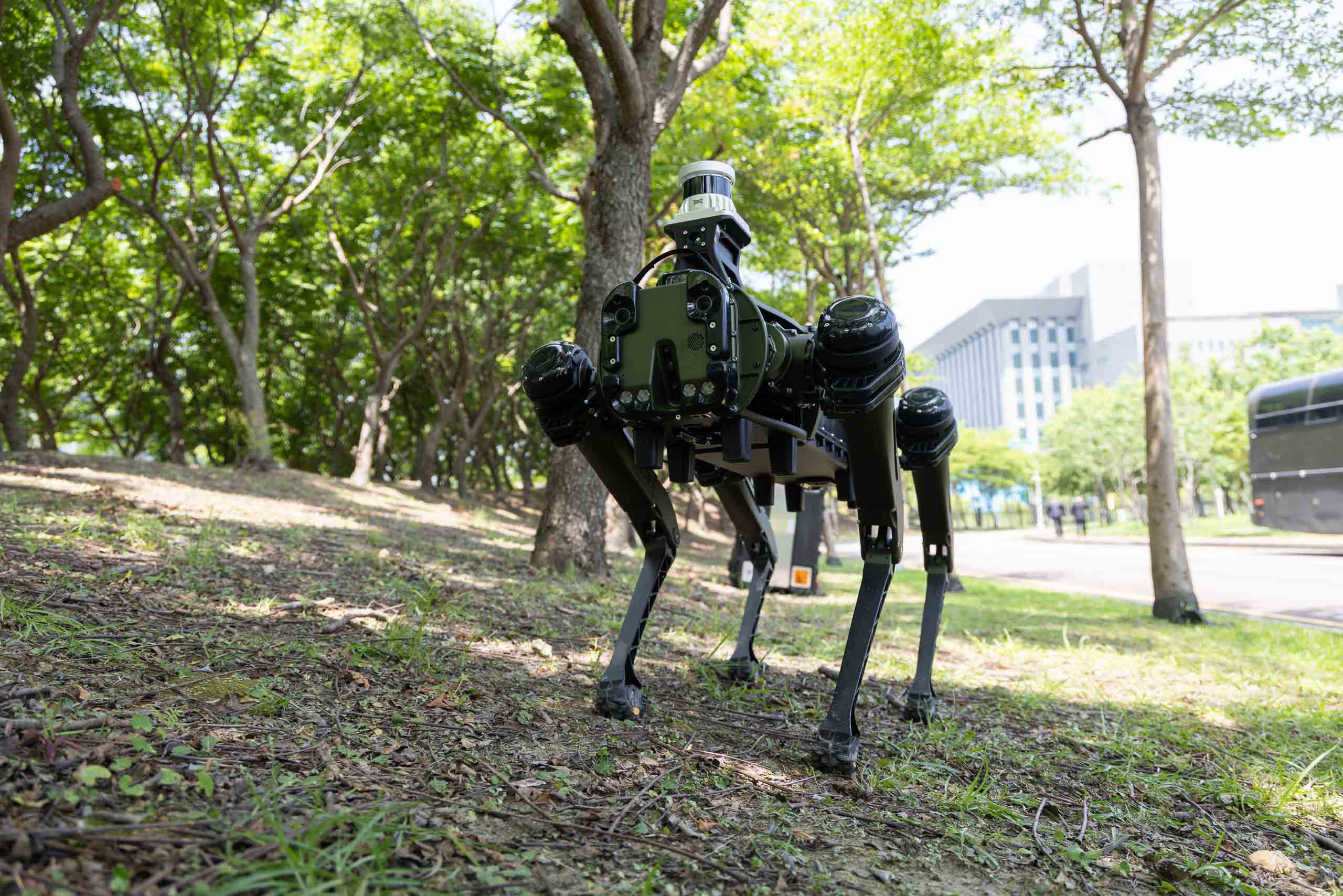
【軍傳媒/國內軍事新聞】國防部日前邀請媒體,展示中科院整合美商Ghost Robotics Vision 60機器狗為載台,衍生研發的「偵蒐型」、「火力型」及「光達型」機器狗,未來將可使用在營區及重要設施巡邏、前線偵查等高風險或需要耗費大量人力的工作。
美商 Ghost Robotics Vision 60,正式定位為 Q-UGV(Quadrupedal Unmanned Ground Vehicle)模組化四足平台。與傳統輪型或履帶式的地面無人載具相比,它可跨越樓梯、碎石、泥地、沙地、草地與都市障礙物,特別適合人員不宜暴露、車輛不易抵達、但仍需要近距離感測與監控的任務環境。
根據官方資料,Ghost Robotics Vision 60具備3小時以上連續行走能力、20小時以上待機能力、IP67全天候防護等級、10公斤酬載能力,最高速度可達2.5公尺/秒;官方另標示其可在攝氏-40至55度環境運作,並強調模組化設計、野外快速維修與開放式架構,方便使用者整合感測器、通訊設備或任務模組。


中科院飛彈火箭研究所副所長任國光說明指出,這次展出的「光電偵蒐型」、「火力型」(鎮暴槍遙控槍塔系統)及「光達結合熱影像辨識型」3型機器狗,其中光電偵蒐型及火力型都是由中科院自主研發自行整合,目的就是建構機器狗具備偵蒐、巡檢、警戒與目標監控能力。
現場動態展示的「光達(LiDAR)結合熱影像辨識型」機器狗,上面的光達並非中科院產品,但系統是由中科院整合,所搭載的32線3D光達與熱影像感測模組可以在平時將園區地圖掃描、具備三維空間建模、自主巡檢、即時避障、環境感知、熱源偵測能力,可事先規劃巡邏路徑,並將相關圖資分享給其他機器狗,需要時呼喚火力型機器狗提供支援,地面無人載具在台灣最先落地的,將有可能是營區巡檢的這塊。
「偵蒐型」機器狗搭載的光電頭是中科院自主研發,於去年的創新展亮相過,由睿鳶無人機上的模組所小改進而來,具備目標搜尋、分析辨識及追蹤能力,並將目獲資訊回傳至「智慧決策指管系統」,也就是說仍需一個類似控制室的中心整合所有機器狗的資訊。
「火力型」機器狗上面搭在中科院研發的遙控槍塔,具中科院表示,相關槍塔主要是在後座力抑制上面需下功夫,設計必須讓機器狗保持穩定且不會損壞任何裝置,這次展示的槍塔上安裝的是鎮暴槍,也可替換成步槍,但因酬載限制無法換成機槍。


國外實際案例
美國空軍2021 年 3 月在佛羅里達州 Tyndall 空軍基地,測試使用Ghost Robotics Vision 60用於機場監視與周界安全。2020 年 9 月 1 日美國空軍 Advanced Battle Management System, ABMS演習,使用人工智慧與快速資料分析,用於偵測並反制安全威脅。2023 年美國空軍第 49 安全部隊中隊在新墨西哥州 Holloman 空軍基地,對于大面積範圍的機場環境,將Ghost Robotics Vision 60用於檢查圍籬缺口、偵測可能突破周界的人員
英國國防部裝備與支援署(DE&S)在2022年也宣布,未來英方加大Ghost Robotics Vision 60的應用評估,英國軍方定義Ghost Robotics Vision 60的潛在任務包括運送關鍵補給、偵察危險區域,以及執行對人員而言風險過高的任務。外界通常認為機器狗就是自主作戰取代士兵,但現階段多數軍事運用仍以「降低人員暴露」與「增加環境感知」為主,而不是完全自主作戰。

未來可能發展
根據中科院人員的說明內容,日前公開的三型機器狗屬於測試驗證原型機,其通訊傳輸仍依賴傳統WiFi,因此距離不可能太長且容易受干擾,未來會逐漸提升至4G/5G的控制,由於目前設定仍屬於承平時期的裝備,暫不考慮基地台被破壞時的環境。目前也只是單方面的將偵蒐環境資訊、畫面回傳到控制中心,未來也會逐漸朝向AI自主運作的方式研發。
台灣未來可能的使用方式,應是從最基本的「基地巡邏工具」開始,逐漸擴展為「替代人員進入危險區」的裝備,四足機器平台在成本、結構複雜度與速度未必優於輪型車,但它能爬樓梯、跨越碎石、穿越草地與室內外混合環境,特別適合基地、港口、能源設施、彈藥庫、地下空間與都市區,將影像、紅外線、熱源、聲音或其他感測資料回傳。最後才邁入「分散式感測網路」的一環,未來戰場強調多源感測、AI判讀與即時回傳,Ghost Robotics Vision 60這類平台若能整合搭配無人機、固定感測器與戰場管理系統,就能在前線或基地內建立更好的環境掌握態勢。

NCSIST Unveils Reconnaissance, Firepower, and LiDAR Robotic Dogs, Building New Unmanned Ground Capabilities
The Ministry of National Defense recently invited the media to observe a demonstration of three robotic dog variants developed by Taiwan’s National Chung-Shan Institute of Science and Technology, or NCSIST. Using the U.S.-made Ghost Robotics Vision 60 as the base platform, NCSIST has integrated and developed reconnaissance, firepower, and LiDAR-equipped robotic dogs. In the future, these systems could be used for high-risk or labor-intensive missions such as patrols at military camps and critical facilities, as well as forward-area reconnaissance.
The Ghost Robotics Vision 60 is formally classified as a Q-UGV, or Quadrupedal Unmanned Ground Vehicle, and is designed as a modular four-legged platform. Compared with traditional wheeled or tracked unmanned ground vehicles, the Vision 60 can move across stairs, rubble, mud, sand, grass, and urban obstacles. This makes it especially suitable for mission environments where personnel should not be exposed, vehicles have difficulty reaching the area, but close-range sensing and monitoring are still required.
According to official specifications, the Ghost Robotics Vision 60 can walk continuously for more than three hours, remain on standby for more than 20 hours, has an IP67 all-weather protection rating, and can carry a payload of up to 10 kilograms. Its maximum speed is 2.5 meters per second. The company also states that the platform can operate in temperatures ranging from minus 40 to 55 degrees Celsius. Ghost Robotics emphasizes its modular design, rapid field repair capability, and open architecture, allowing users to integrate sensors, communications equipment, or mission modules according to operational needs.
Jen Kuo-kuang, deputy director of NCSIST’s Missile and Rocket Systems Research Division, explained that the three robotic dog variants displayed this time were an electro-optical reconnaissance model, a firepower model equipped with a remote weapon station using a riot-control gun, and a LiDAR model combined with thermal imaging recognition. Among them, the electro-optical reconnaissance model and the firepower model were independently developed and integrated by NCSIST. Their purpose is to give the robotic dog reconnaissance, inspection, security, and target-monitoring capabilities.
The LiDAR and thermal imaging recognition robotic dog demonstrated on site was equipped with a LiDAR unit that was not produced by NCSIST, but the overall system integration was carried out by NCSIST. The platform carries a 32-line 3D LiDAR and a thermal imaging sensor module. During normal operations, it can scan and map a facility, build three-dimensional spatial models, conduct autonomous patrols, avoid obstacles in real time, perceive its surrounding environment, and detect heat sources. Patrol routes can be planned in advance, and relevant mapping data can be shared with other robotic dogs. When necessary, it can also call upon the firepower variant to provide support. In Taiwan, the first practical use of unmanned ground vehicles may very likely begin with patrol and inspection missions inside military bases.
The reconnaissance variant is equipped with an electro-optical turret independently developed by NCSIST. The turret had previously appeared at last year’s innovation exhibition and was adapted from a module used on the Rui Yuan unmanned aerial vehicle. It has target search, analysis, recognition, and tracking capabilities, and can transmit target acquisition information back to an intelligent decision-making command-and-control system. In other words, the system still requires a control-room-like command center to integrate information from all robotic dogs.
The firepower variant carries a remote weapon station developed by NCSIST. According to the institute, the key technical challenge for this weapon station lies in recoil suppression. The design must allow the robotic dog to remain stable without damaging any onboard equipment. The weapon station displayed this time was fitted with a riot-control gun, but it can also be replaced with a rifle. However, due to payload limitations, it cannot be upgraded to carry a machine gun.
Overseas Operational Examples
In March 2021, the U.S. Air Force tested the Ghost Robotics Vision 60 at Tyndall Air Force Base in Florida for airfield surveillance and perimeter security. Earlier, on September 1, 2020, during the U.S. Air Force’s Advanced Battle Management System, or ABMS, exercise, the system was used alongside artificial intelligence and rapid data analysis to detect and counter security threats. In 2023, the U.S. Air Force’s 49th Security Forces Squadron at Holloman Air Force Base in New Mexico used the Ghost Robotics Vision 60 in a large airfield environment to inspect fence-line breaches and detect personnel who might attempt to penetrate the perimeter.
The United Kingdom’s Defence Equipment and Support agency, or DE&S, also announced in 2022 that it would expand its assessment of the Ghost Robotics Vision 60. The British military has identified potential missions for the platform, including transporting critical supplies, reconnoitering hazardous areas, and carrying out missions that would be too dangerous for personnel. Although robotic dogs are often imagined by the public as autonomous combat systems replacing soldiers, most current military applications still focus on reducing human exposure and improving environmental awareness, rather than fully autonomous combat.
Possible Future Development
According to NCSIST personnel, the three robotic dog variants recently made public are still test and verification prototypes. Their communications currently rely on traditional Wi-Fi, meaning their operating range cannot be very long and they are vulnerable to interference. In the future, control links are expected to gradually shift toward 4G and 5G communications. Since the current configuration is still designed for peacetime operations, scenarios in which base stations are destroyed are not yet a major consideration. At present, the system mainly transmits reconnaissance data and video feeds one way back to the control center. Future development will gradually move toward AI-enabled autonomous operations.
Taiwan’s likely future use of such systems will probably begin with the most basic role: base patrol. From there, robotic dogs may gradually expand into equipment that can replace personnel in dangerous areas. Four-legged robotic platforms may not necessarily outperform wheeled vehicles in terms of cost, structural simplicity, or speed. However, their advantage lies in the ability to climb stairs, cross rubble, move through grass, and operate in mixed indoor and outdoor environments. This makes them especially suitable for military bases, ports, energy facilities, ammunition depots, underground spaces, and urban areas, where they can transmit video, infrared imagery, heat-source data, audio, or other sensor information.
In the long term, such platforms may become part of a distributed sensing network. Future battlefields will place increasing emphasis on multi-source sensing, AI-assisted interpretation, and real-time data transmission. If platforms such as the Ghost Robotics Vision 60 can be integrated with unmanned aerial vehicles, fixed sensors, and battlefield management systems, they could help establish a clearer and more complete picture of the environment, whether at the front line or inside military facilities.