

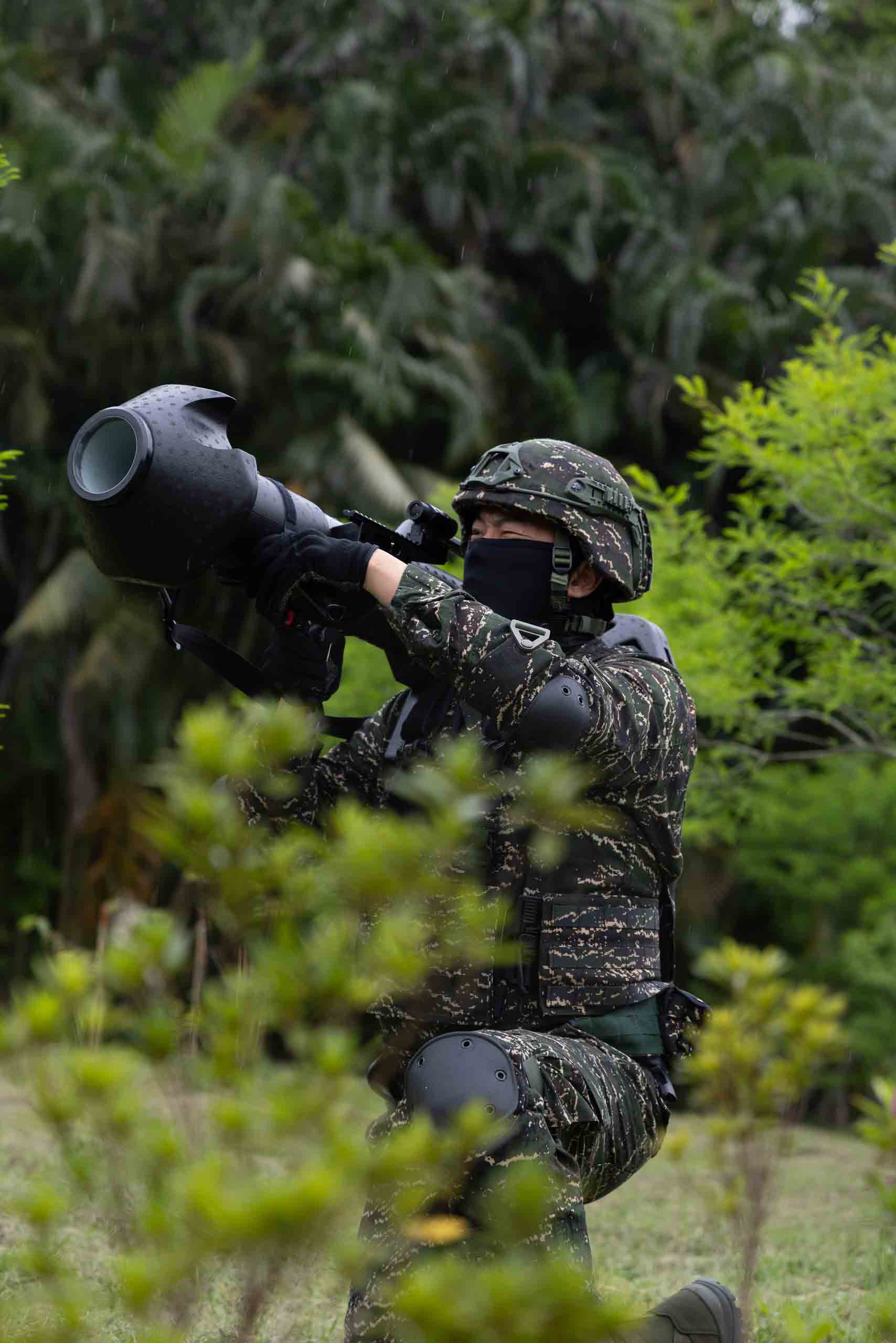
【軍傳媒/國內軍事新聞】日前通過的7800億元國防特別條例預算,主要以對美軍購項目為核心;相較之下,軍購之外的國內自研與商購採購預算,則在立法院審查過程中遭到刪除。這樣的結果,也讓外界重新關注台灣國防自主的實際成果與說服力。
中科院日前首度公開自民國113年開始研製的「紅隼二型」反裝甲火箭彈,具有相當重要的象徵與實質意義。這次公開不只是單一武器性能提升的展示,也是在向社會說明,國內自研項目不應一概被視為高風險或低效率,只要研發方向正確、部隊願意實際使用並提供回饋,台灣仍然能研製出符合需求、成本相對合理,且具備實戰價值的國產武器。
目前陸軍仍有部分單位使用老舊的66火箭彈。66火箭彈有效射程約200公尺,穿甲能力約25公分,面對現代戰場上的裝甲車輛與城鎮作戰環境已無法應付。而紅隼火箭彈的研發目的,正是為了取代66火箭彈,將有效射程提升至400公尺,穿甲能力提高至約30公分。紅隼二型則在此基礎上進一步強化,有效射程提升至500公尺,穿甲能力達60公分。以公開數據來看,其穿甲能力已接近或達到部分美軍現役反裝甲火箭的水準,在武器威力上並不遜於國外同級產品。

不過數年過去了,紅隼系列在國軍內部的使用情況卻出現明顯差異。海軍陸戰隊長期是紅隼一型的重要使用者,對其性能與成本效益給予正面評價,而陸戰隊每年進行數十發實彈射擊的經驗,也成為中科院改良紅隼二型的重要參考。這種「部隊使用、實彈驗證、回饋研發、持續改良」的循環,正是國防自主最需要建立的良性模式。
相較之下,陸軍對紅隼反裝甲火箭的採購與實彈使用態度較為保守。雖然陸軍司令部在115-116年編列12 億 380 萬元採購紅隼火箭,但實際上陸軍仍傾向以美方AT4反裝甲火箭為主要選項,認為紅隼反裝甲火箭的性價比不如國外。從單一武器成熟度來看,AT4確實是服役經驗豐富的成熟產品;但若從國防自主、戰時補給與大量消耗的角度來看,過度依賴外購武器,可能會削弱國內研發成果進入部隊驗證與量產成熟的機會。而紅隼二型的研發成功讓此採購又有了一線生機。
根據軍政人士透露,當時預算編列並沒有明確寫是紅隼一型,且紅隼二型是中科院自費研究,因此在採購時以更先進的紅隼二型交付是符合法律的規範,部隊也能買到更先進的產品,這也是國防自主的好處,避免預算編列到執行時總採購到過時的裝備。

美軍AT4反裝甲火箭重量約7公斤,長度約1公尺,初速可達284公尺/秒,因此能以較小的84公厘彈徑達到約42公分的穿甲能力。台灣面對的並不是短時間、小規模的武器採購需求,而是可能在戰時大量消耗、長期補充與持續訓練的基層反裝甲火力需求。從俄烏戰爭經驗來看,反裝甲火箭這類單兵武器一旦進入高強度戰場,消耗量往往極高,俄烏戰爭時期烏方就多次向世界各國發出每年採購一萬枚反裝甲火箭的需求。因此能夠國產化、低單價、容易補充的反裝甲火箭,在採購成本、訓練密度與後勤維持上,對台灣具有相當重要的戰略價值。
經過兩年改進研發,紅隼二型吸收第一代使用者經驗,主要朝向輕量化、室內發射能力與瞄準系統強化等方向改良。室外型已於今年上半年完成Developmental Testing,研發測試,預計下半年完成Initial Operational Test and Evaluation,也就是初期作戰測試與評估。室內型則因抑制器模組研發時程較長,進度較室外型晚約半年,預計後續完成DT研發測試與IOT&E初期作戰測試與評估。
紅隼一型與紅隼二型火箭彈的主要諸元如下:
| 系統 | 紅隼二型室外型 | 紅隼二型室內型 | 紅隼一型 |
| 發射器重量 | 3.9公斤 | 6.5公斤 | 3.5公斤 |
| 發射器長度 | 1.16公尺 | 1.45公尺 | 1.1公尺 |
| 火箭彈重量 | 3.5公斤 | 3.5公斤 | 1.6公斤 |
| 總重量 | 7.4公斤 | 10公斤 | 5.1公斤 |
| 彈徑 | 96公厘 | 96公厘 | 67公厘 |
| 初速 | 215公尺/秒 | 186公尺/秒 | 134公尺/秒 |

紅隼二型室外型與室內型的主要差異,在於室內型增加了一段抑制器模組。一般火箭彈射擊時,發射筒後方會產生高溫尾焰、強烈爆音與爆壓。如果射手在狹窄室內空間或半封閉掩體內發射,後方爆壓與聲響反射可能對射手造成傷害,也會限制武器在城鎮戰中的使用彈性。
為了解決這個問題,中科院特別投入抑制器設計。系製中心計畫主持人黃志清表示,雖然相關細節無法完全公開,但其原理大致是讓火焰通過液體後氣化降溫,同時利用反作用力減少向後的爆壓,使其符合美軍MIL-STD-1474E規範。紅隼二型室內型可將溫度降低至攝氏80度,壓力控制在5psi以內,聲音不超過180分貝,可在一公尺見方的鐵皮空間發射,外型上也參考法國APILAS反裝甲火箭的前段導流設計,以進一步保護射手安全。
室內發射能力對台灣防衛作戰具有特別重要的意義。台灣可能面對的戰場環境,不會只限於開闊灘岸或野外地形。港區、重要道路交會點、橋梁、機場周邊、城鎮街道與高密度建築物,都可能成為阻絕敵方裝甲車輛、登陸載具與機械化部隊推進的重要區域。若反裝甲火箭只能在開闊空間使用,射手就必須暴露在敵方無人機、火砲、狙擊手與車載火力威脅之下,生存性將大幅降低。
相反地,若反裝甲火箭具備室內或半封閉空間發射能力,射手就能利用建築物、掩體或預設伏擊位置進行射擊,並在射擊後迅速轉移。當敵方裝甲車輛進入城鎮道路、港區周邊或狹窄交通要道時,紅隼二型室內型可從側面、後方,甚至不同樓層與高度位置形成多方向威脅。這將使敵方即使突破第一線,也必須面對分散、密集且難以預測的近距離反裝甲火網。
除了室內射擊能力外,俄烏戰爭也顯示,遙控射擊與無人地面載具正在快速改變前線防禦型態。烏克蘭近年大量運用遙控武器站、無人地面車與機械化火力模組,使士兵能在較安全的位置操控機槍、榴彈發射器或其他武器系統,對敵方步兵、輕裝甲車輛與固定火力點進行打擊。這類系統的核心價值,不是完全取代士兵,而是讓射手從最危險的射擊位置後撤,降低人員暴露,同時讓防禦陣地具備更長時間的監視、待機與火力輸出能力。

Wartime Sustainment Cannot Rely Solely on Foreign Procurement: Kestrel II Fills Taiwan Army’s Urban Defense Gap
Following the passage of Taiwan’s NT$780 billion special defense budget bill, procurement priorities have focused largely on U.S. arms sales, while many domestic R&D and commercial procurement programs were cut during legislative review. The outcome has once again sparked debate over the credibility and future of Taiwan’s defense self-reliance strategy.
Against this backdrop, the National Chung-Shan Institute of Science and Technology (NCSIST) recently unveiled the “Kestrel II” anti-armor rocket system, a development carrying both symbolic and practical significance. The public debut was not merely about showcasing improved weapon performance; it was also intended to demonstrate that domestic defense projects should not automatically be viewed as inefficient or high-risk. When development priorities align with operational needs and frontline units actively provide feedback, Taiwan is still capable of producing practical, cost-effective, and combat-relevant indigenous weapons.
The Taiwanese Army still operates aging 66 rocket launchers in some units. Those systems have an effective range of roughly 200 meters and armor penetration of about 25 centimeters, making them increasingly inadequate against modern armored threats and urban warfare conditions. The original Kestrel rocket launcher was designed as a replacement, extending the effective range to 400 meters and improving penetration to roughly 30 centimeters. The new Kestrel II further expands performance, reaching an effective range of 500 meters with penetration capability reportedly up to 60 centimeters. Based on publicly available data, its armor penetration is approaching — or in some cases matching — certain currently fielded U.S. anti-armor rocket systems.
Despite these improvements, adoption within Taiwan’s military has varied significantly. Taiwan’s Marine Corps has long been one of the primary users of the original Kestrel system and has generally praised its effectiveness and cost efficiency. The Marines’ extensive annual live-fire exercises also provided valuable operational feedback that directly influenced the development of Kestrel II. This cycle — frontline use, live-fire validation, operational feedback, and continuous improvement — represents the type of defense industrial ecosystem Taiwan urgently needs to build.
The Army, however, has remained comparatively cautious regarding large-scale Kestrel procurement and operational use. Although Taiwan’s Army allocated approximately NT$1.2 billion for Kestrel procurement in fiscal years 2026–2027, it has continued to favor the U.S.-made AT4 anti-armor launcher as its primary solution, arguing that the Kestrel’s cost-performance ratio is less competitive. From the perspective of combat maturity alone, the AT4 is undoubtedly a highly proven system with decades of operational history. Yet from the perspective of wartime sustainability, domestic production capacity, and mass battlefield consumption, overreliance on foreign systems may reduce opportunities for Taiwan’s indigenous defense industry to mature through operational deployment and large-scale production.
The successful development of Kestrel II may now reopen that debate.
According to defense sources, the original procurement budget did not explicitly specify the first-generation Kestrel, and because Kestrel II was developed through NCSIST self-funded research, replacing earlier versions with the more advanced system remains legally compliant. This also highlights one advantage of domestic defense production: avoiding situations where lengthy procurement cycles result in outdated equipment by the time systems are finally delivered.
The U.S. AT4 weighs approximately seven kilograms, measures around one meter in length, and achieves armor penetration of roughly 42 centimeters despite its relatively compact 84mm caliber. Taiwan’s challenge, however, is not limited to acquiring small quantities of advanced anti-armor weapons. In a potential high-intensity conflict, Taiwan would likely face prolonged combat involving massive consumption of infantry anti-armor munitions, continuous replenishment requirements, and sustained training demands.
The Russia-Ukraine War demonstrated that disposable infantry anti-armor weapons can be consumed at extraordinary rates during modern warfare. Ukraine repeatedly requested tens of thousands of anti-armor launchers annually during periods of intense fighting. For Taiwan, therefore, the ability to domestically produce low-cost, rapidly replaceable anti-armor rockets carries major strategic value in terms of procurement affordability, logistics sustainability, and long-term battlefield endurance.
After two years of redesign and operational feedback, Kestrel II introduces major improvements focused on reduced weight, indoor firing capability, and upgraded targeting systems. The outdoor-launch version completed developmental testing earlier this year and is expected to finish Initial Operational Test and Evaluation (IOT&E) later this year. The indoor-launch variant remains slightly behind schedule due to the complexity of its blast suppression module but is expected to complete testing afterward.
The most important distinction between the indoor and outdoor variants lies in the indoor model’s blast suppression system. Conventional rocket launchers generate extremely dangerous backblast, heat, and overpressure behind the launcher during firing. In confined spaces such as buildings, bunkers, or narrow urban environments, these effects can seriously injure the operator and limit tactical flexibility.
To solve this problem, NCSIST developed a dedicated suppression module. According to project manager Huang Chih-Ching, although many details remain classified, the system works by cooling exhaust gases through liquid vaporization while simultaneously reducing rearward blast pressure through counterforce management. The design reportedly complies with U.S. MIL-STD-1474E standards. The indoor-launch version can reduce internal temperatures to around 80 degrees Celsius while keeping pressure below five psi and sound levels under 180 decibels, allowing safe firing even inside confined metal structures approximately one meter wide.
This indoor firing capability is especially important for Taiwan’s defense strategy. Taiwan’s future battlefield will likely involve dense urban terrain, ports, transportation chokepoints, bridges, airports, and coastal cities rather than only open beaches or rural terrain. If anti-armor launchers can only be used in exposed environments, operators become highly vulnerable to drones, artillery, snipers, and vehicle-mounted weapons.
Indoor-launch capability changes this equation. Soldiers can fire from inside buildings, fortified positions, or concealed ambush points and rapidly relocate afterward. Enemy armored vehicles moving through urban streets, ports, or narrow transportation corridors could face anti-armor attacks from multiple directions, elevations, and hidden positions. Even if enemy forces penetrate frontline defenses, they would still face dense and highly unpredictable close-range anti-armor kill zones.
Beyond indoor launch systems, the Russia-Ukraine War has also demonstrated how remote-controlled weapons and unmanned ground systems are reshaping frontline defense. Ukraine has extensively deployed remote weapon stations, unmanned ground vehicles, and mechanized fire support modules, allowing operators to engage infantry, light armored vehicles, and fixed positions from safer locations.
The true value of these systems is not replacing soldiers entirely, but pulling operators away from the most dangerous firing positions while maintaining persistent surveillance and sustained firepower. In this context, systems like Kestrel II represent more than simply upgraded rocket launchers — they reflect Taiwan’s broader need to adapt infantry warfare concepts to the realities of modern high-intensity combat.