

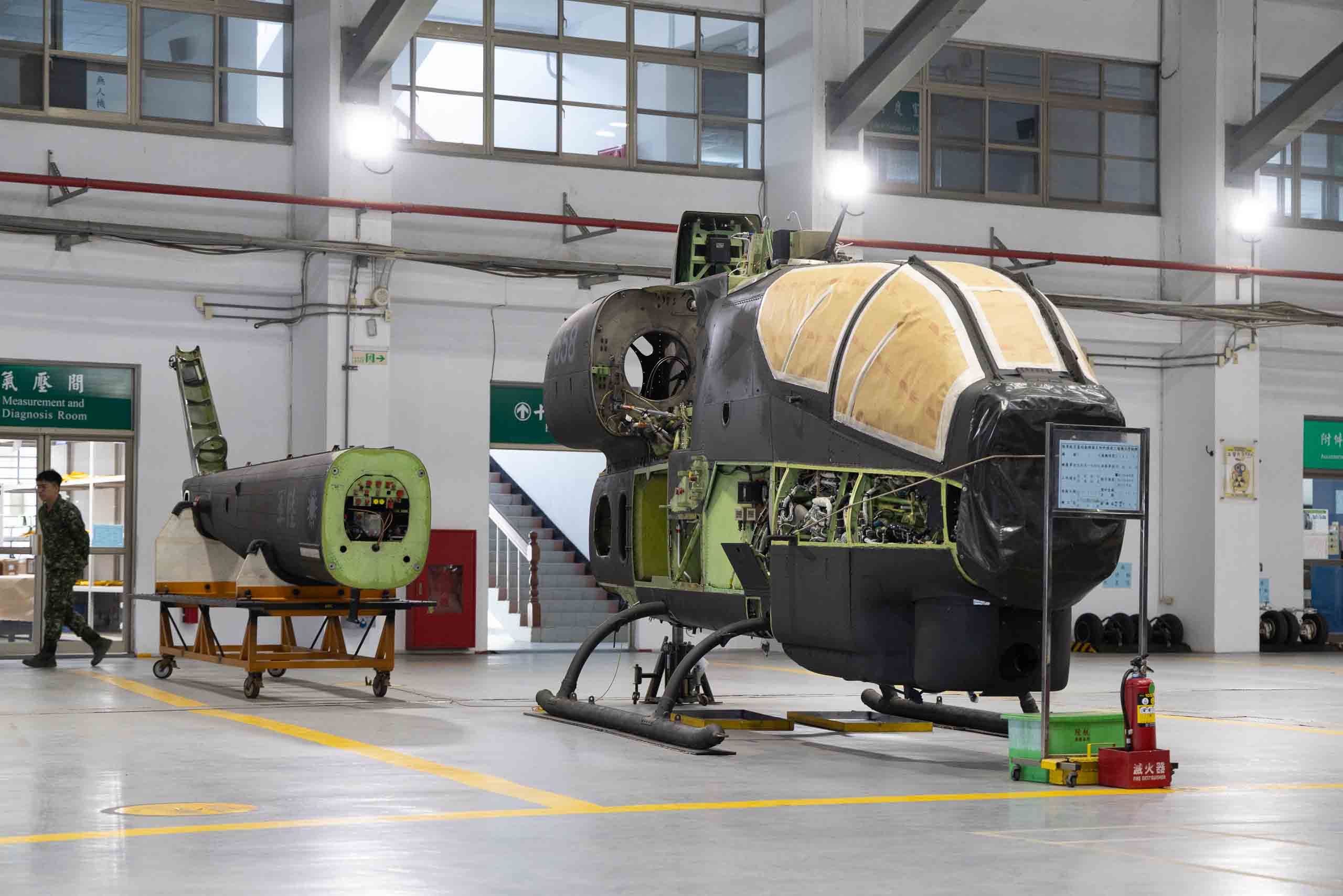
【軍傳媒/軍風大觀園】任職於陸軍航空基地勤務廠品質管理科的陸軍高中66期(94年班)士官長 陳佾成,主要負責旋翼直升機的電氣系統修復,一般直升機上的導航系統、通訊系統等都包括在內。

海島環境下的腐蝕威脅與維護對策。
由於台灣屬於海島型氣候,只要飛機有執行海上甚至只是沿海飛行任務後,蔥器中的高濃度鹽分子就會佈滿機身外部,甚至是被發動機吸入內部,一般外觀部分容易清洗,每次飛行任務後也會經過飛機清洗機洗去外部附著鹽分,但在渦輪葉片、航電武器系統之電氣接頭、機體結構及旋轉零件接縫處的空隙容易堆積氧化物,輕則可能導致發動機燃燒效率下降、電子訊號收發異常,重則產生鏽坑裂痕等嚴重問題影響飛安。
為了因應這種狀況,一般來說會在平時定期保養時就針對各系統電子接頭結構縫隙等關鍵部位噴塗化學防鏽劑,在承受高應力結構部位執行定期的非破壞檢查;而在飛行任務後落實機體清洗、發動機清洗及內部航電艙除濕作業,方能有效維持發動機最佳動力,並確保航電武器系統不易短路失效。

旋翼系統與壽限管理的關鍵機制
另外在直升機上,由於靠旋翼產生升力,因此主旋翼、尾旋翼、以及傳動軸、傳動箱是飛機最重要的部件之一,而戰鬥直升機常需要做高應力的機動飛行動作,因此相關部位的壽命件管理就是戰鬥直升機維護的核心。陳佾成士官長就表示,針對主旋翼、尾旋翼與主傳動箱壽限管理,主要以技令規範之「飛行時數或操作時間」為基礎,藉「金屬屑偵測預警系統」、定期或不定期「震動分析及非破壞檢測」,並輔以飛行前後360度目視檢查等機制,隨時更換不合格件。
而常見損壞徵候諸如主/尾旋翼「前緣抗磨條剝離、葉片蒙皮接合處裂紋或脫層、飛行中產生過大震動」及主傳動箱「輸出(入)軸滲油、運轉異常震動或噪音、滑油變色或異味」等,若超出技令規範範圍,縱使時數剩餘再多,也必須以安全為優先強制更換,確保飛行安全。


X光非破壞檢測與戰時挑戰
講到非破壞性檢查,目的就是在不確定損壞的前提上,避免飛機拆檢的二次損傷及降低人為的錯誤風險,獲得比肉眼更深層、更準確的判斷。現行主要針對飛機的應力結構,以大型X光檢測設備來檢查我們飛機的內部結構,藉由即時提供的數位成像來快速判讀飛機的狀況,或結構是否有金屬疲勞的現象等,就像是飛機的健康檢查,讓修護人員及時發現問題加以處置。
陸軍航勤廠擁有國內唯一的直升機全廠房X光檢測,整座機棚完全包覆,內部還有移動式鉛板牆,用以隔絕X光的外洩,而相關工作人員都有佩戴輻射偵測器,操作人員的劑量檢查頻率更是每個月一次,確保工作人員的安全,國防部每年也會提供相關人員的全身健檢。

主要的輻射發射器(俗稱水管頭)是一個管狀物,可以調整放射的角度,也可以架高放低由不同的角度來照射,不過都是以人力移動,另外輻射發射器可以由遙控控制器從外面操作拍攝。照完X光後,在外面的控制室就會產生即時的數位影像檔,由專業檢驗士官長帶領團隊判別,針對有疑慮的地方做進一步檢視。
由於每次輻射發射器的輻射發射角度有限,而要完全照完一架直升機需要移動20到30個不同位置,且每個位置的X光照射量因結構的材質、深度等都有不同,照射量太高,所有結構都是透明看不出來,太低又無法穿透導致畫面一片白,因此一架飛機完整照射都需要一天的時間。一般來說直升機只要受力的地方會在底部,另外像CH-47SD以及UH-60M的機腹掛鉤也都是特別要注意的地方。
航勤廠的X光檢測廠每年都會接受不同單位的督導檢測,除了原委會固定的檢測確保安全外,相關的證照一個都不少,而陸軍司令部、國防部等上級單位也會不定期督導,確保一切都依照流程合乎規定。不過在戰時這種固定設備就會成為容易打擊的對象,由於有電力及校準的需求,許多大型裝備無法移動,因此未來廠房的抗彈防護或地下化,也是陸軍需要加強的方向。


Invisible Wear: Electrical and Structural Safety Maintenance in Helicopters
Sergeant Major Chen Yi-Cheng serves in the Quality Management Section of the Army Aviation Logistics Depot, where he is responsible for the maintenance and repair of electrical systems in rotary-wing aircraft. His work covers a wide range of systems, including navigation and communication systems commonly found on helicopters.
One of the most significant challenges in Taiwan is its island-based maritime environment. After helicopters conduct missions over the sea or even along coastal areas, high concentrations of salt particles accumulate on the aircraft’s exterior and may even be ingested into the engine. While external salt deposits can be removed through routine washing procedures, residual salt and oxidized particles tend to accumulate in less accessible areas such as turbine blades, electrical connectors within avionics and weapon systems, structural joints, and gaps between rotating components.
These accumulations may lead to reduced engine combustion efficiency, abnormal electronic signal transmission, and in severe cases, corrosion pitting or structural cracking that can directly impact flight safety. To mitigate these risks, maintenance units apply chemical anti-corrosion agents to critical areas such as electrical connectors and structural gaps during routine servicing. In addition, high-stress structural components undergo periodic non-destructive inspections. After each mission, thorough aircraft washing, engine cleaning, and dehumidification of avionics compartments are conducted to ensure optimal engine performance and prevent short circuits or system failures.
Another key aspect of helicopter maintenance lies in the rotor system and component life-cycle management. Helicopters rely on rotor systems to generate lift, making the main rotor, tail rotor, transmission shafts, and gearboxes among the most critical components. Combat helicopters frequently perform high-stress maneuvers, which places additional strain on these parts. As a result, life-limit management becomes a central element of maintenance.
According to Sergeant Major Chen, the service life of key components such as the main rotor, tail rotor, and main gearbox is managed based on technical manuals that define limits in terms of flight hours or operating time. Monitoring systems such as chip detectors provide early warnings of internal wear, while periodic or unscheduled vibration analysis and non-destructive testing are used to assess structural conditions. These methods are complemented by comprehensive 360-degree visual inspections conducted before and after flights, ensuring that any unqualified components are promptly replaced.
Common signs of damage include erosion or detachment of leading-edge protective strips on rotor blades, cracks or delamination at bonding areas, and excessive vibration during flight. In the main gearbox, warning signs may include oil leakage from input or output shafts, abnormal vibration or noise, and discoloration or unusual odor in lubricating oil. Even if a component has remaining service life, it must be replaced immediately if it exceeds acceptable limits, as safety always takes priority.
Non-destructive testing, particularly X-ray inspection, plays a vital role in modern maintenance practices. The primary purpose is to evaluate structural integrity without disassembling components, thereby avoiding secondary damage and reducing the risk of human error. Using large-scale X-ray systems, maintenance personnel can examine internal structures and quickly determine whether issues such as metal fatigue are present. This process is often compared to a “health check” for aircraft, enabling early detection and timely corrective action.
The Aviation Logistics Depot operates the only full hangar X-ray inspection facility for helicopters in Taiwan. The entire hangar is enclosed, with movable lead shielding walls installed inside to prevent radiation leakage. Personnel working in the facility are required to wear radiation monitoring devices, and exposure levels are checked monthly to ensure safety. In addition, the Ministry of National Defense provides annual comprehensive health examinations for relevant staff.
The primary radiation source, commonly referred to as the “tube head,” is a tubular device that can be adjusted in angle and height to capture images from different perspectives. It is manually repositioned and remotely operated from outside the hangar using a control system. Once scanning is completed, digital images are generated in real time in the control room, where inspection teams led by experienced senior NCOs analyze the data and identify areas requiring further examination.
Because each radiation exposure covers only a limited area, inspecting an entire helicopter requires repositioning the equipment across approximately 20 to 30 different locations. The radiation intensity must be carefully calibrated depending on material composition and structural depth. Excessive exposure may result in overly transparent images with insufficient detail, while insufficient exposure may fail to penetrate the structure, producing unusable results. Consequently, a complete X-ray inspection of a helicopter typically takes an entire day.
Special attention is given to load-bearing sections, which are often located on the lower parts of the aircraft. Components such as cargo hooks on helicopters like the CH-47SD and UH-60M are particularly critical due to the stresses they endure during operations.
The X-ray inspection facility is subject to regular audits and inspections by multiple authorities. In addition to routine oversight by nuclear regulatory agencies, all necessary certifications are maintained, and higher-level organizations such as Army Headquarters and the Ministry of National Defense conduct periodic evaluations to ensure compliance with established procedures.
However, in wartime scenarios, such large fixed facilities may become vulnerable targets. Due to their reliance on stable power supply and precise calibration, many of these systems are not easily mobile. As a result, enhancing protective measures, including hardened structures or underground facilities, has become an important consideration for future development.
In conclusion, while often unseen, the work of electrical and structural maintenance personnel is essential to sustaining helicopter operations. Their efforts ensure that aircraft remain reliable, safe, and capable of performing missions even under demanding environmental and operational conditions.