

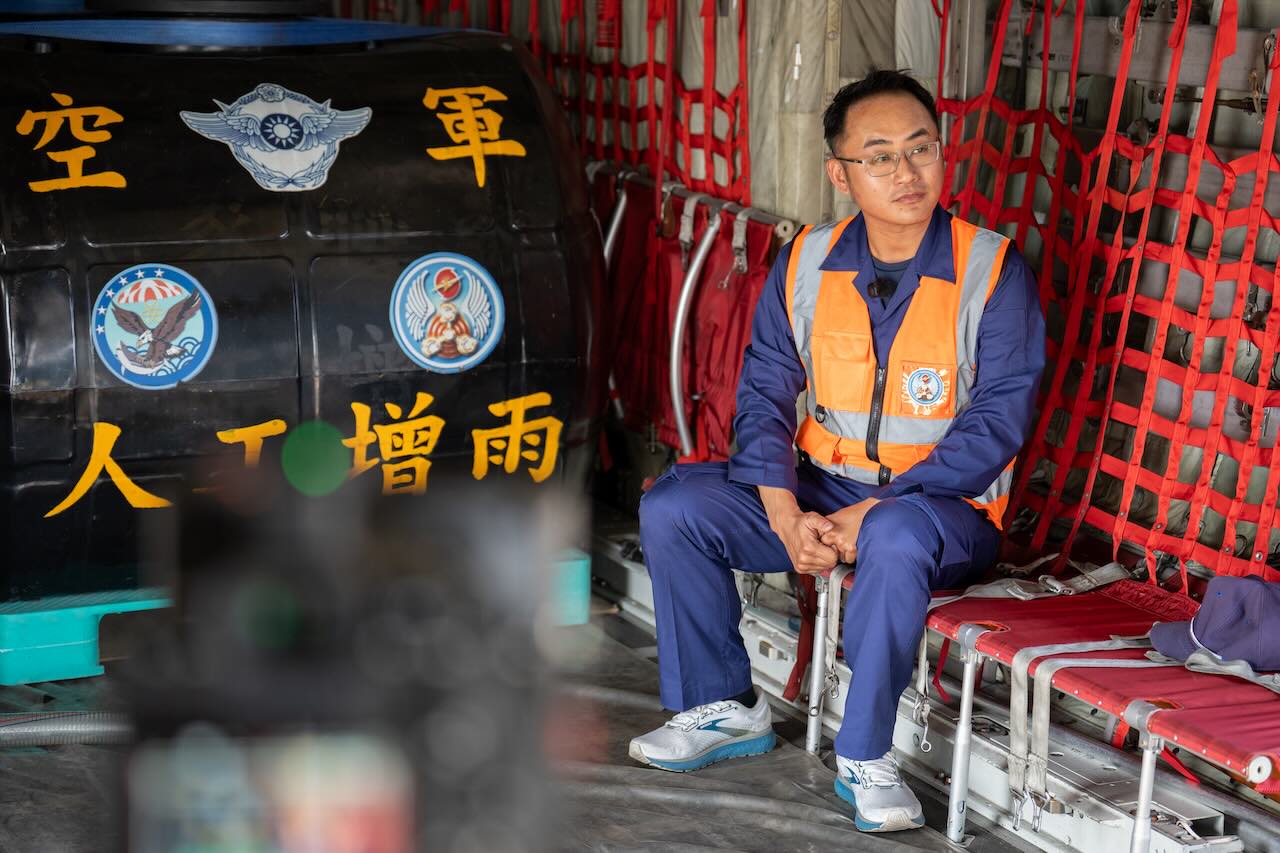
【軍傳媒/從軍我驕傲】從軍23年的陳基鴻士官長,目前任職於空軍第六天氣中心班長,平時負責教育訓練及督導士官兵的氣象觀測作業。家住屏東的他,原本是讀資訊管理系,後來到屏科大進修資訊研究所,報考後先放榜的是空軍,因此就選擇空軍,而加入空軍後認為氣象士可以學到許多的東西,因此直接就選擇氣象聯隊。
整個從軍過程中,陳基鴻士官長不斷地累積經驗,加上單位自訓及前輩的傳承,如今陳基鴻士官長已成為可獨當一面的氣象士,他回憶起從軍經歷中,曾經有一次戰備道操演,當時還是上士的他,很興奮地迎接難得的任務,但任務當天卻下起傾盆大雨導致任務取消,這個遺憾一直到十年之後,陳基鴻升上士官長才有機會執行。

由於戰備道起降牽涉到許多種機型,加上不容有任何的疏失,整個準備工作花了將近一年的時間,不斷地演練、模擬,天氣中心也派出機動式觀測裝備支援現地的天氣觀測,收集當地的天氣資訊,雖然到任務前一天都還在下雨,任務當天天氣突然轉好,甚至連地面都乾了,整個任務順利完成,也成為他從軍過程中特殊的經歷。
當遇到像戰備道起降、或是支援陸軍航空隊直升機的野戰起降時,空軍天氣中心就會使用「移動式氣象觀測系統」高約3公尺,總重十數公斤,可替代機場的固定式觀測系統。系統上方的感測元件可以收集風向、風速、溫度、露點、濕度、雨量、氣壓等資訊,以一片太陽能板供電,收集到的資訊藉由傳輸器傳至手提電腦進行分析,這套系統由兩個氣象士操作,一個士官長帶領,除了機動式任務之外,也可支援天然災害的觀測。


另外人工增雨也是陳基鴻士官長的職責範圍,由於人工增雨任務需要足夠厚度、且水氣充足的積雨雲,當接到人工增雨任務時,會藉由天氣中心提供的各空層濕度、風向、風速等資料,結合衛星雲圖、風面系統等資料,並參考歷年的氣候統計,研判利於雲系發展及降雨區域來訂定任務區域,以提升降雨成功率。由於大氣條件變化快速,適合時機轉瞬即逝,因此陳基鴻士官長會帶領團隊迅速將原本就整備好的器材安裝上C-130運輸機,確保能即時執行任務。
預報的本質在於測報,平日透過持續天氣觀測監控的經驗累積,再比對天氣預測圖與實際天氣的落差,如此成為一完整的天氣預報。單位平時透過計劃培育、預劃派指,以及不定期薦舉優秀人材至軍中或民間研究所課程繼續研習深造。
陳基鴻士官長表示,近兩年由於地球氣候改變,乾旱與雷暴並存、雲係變異加劇、季節性降雨集中、降雨分布不均,也有一整年午後雷陣雨大幅減少,雷雨都沒下在本場的情況,也有完全相反的時期,不過不論是什麼情況,都會回到氣象人員的本職學能,因此不斷精進是唯一的目標。
從軍23年後,陳基鴻士官長如今與家人一同出行時,光以肉眼就可以分辨生活上天氣的變化,且都有一定的準確度,這種生活與工作上的結合讓他很有成就感,甚至小孩耳濡目染下也對大氣狀況有基本的認識,由於家人都體諒軍人的工作型態,未來陳基鴻也將持續在單位服務。


Watching the Skies: A 23-Year Journey of an Air Force Meteorological NCO
For Senior Master Sergeant Chen Ji-Hong, a veteran weather specialist in the Republic of China Air Force, the sky has never been just scenery—it has been his battlefield, his responsibility, and his lifelong discipline. After 23 years of service, Chen now serves as a section leader at the Air Force Sixth Weather Center, where he oversees training and supervises daily meteorological observation operations conducted by enlisted personnel.
Originally from Pingtung in southern Taiwan, Chen did not begin his academic path with meteorology in mind. He studied Information Management and later pursued graduate-level coursework in information systems at National Pingtung University of Science and Technology. When the time came to enter military service, the Air Force was the first to release admission results, and he chose that path. After joining, he discovered that the meteorological field offered a unique combination of science, operational relevance, and continuous learning. That realization led him to commit fully to the Air Force Weather Wing.
Over the years, Chen steadily accumulated hands-on experience, supported by unit-level training and mentorship from senior personnel. Through this process, he developed into a fully capable meteorological specialist, able to operate independently under demanding conditions. Reflecting on his career, one particular moment stands out. Early in his service, while still a Staff Sergeant, he participated in preparations for a highway strip exercise—an operation that allows aircraft to take off and land on specially prepared sections of roadway in wartime scenarios. It was a rare and exciting opportunity, but on the day of execution, heavy rainfall forced the mission to be canceled. That disappointment lingered for years. A decade later, after being promoted to Senior Master Sergeant, he finally had the chance to take part in such an operation again—and this time, successfully.
Highway operations involve multiple aircraft types and require zero margin for error. Preparation for the mission took nearly a year, with repeated rehearsals and simulations. The weather unit deployed mobile observation systems to the site, collecting localized meteorological data to support decision-making. Even on the day before execution, heavy rain persisted. Yet on the actual day of the operation, weather conditions suddenly improved—the skies cleared, and even the ground dried sufficiently. The mission was completed smoothly, becoming one of the most memorable milestones in Chen’s career.
For operations such as highway takeoffs or supporting Army aviation helicopter landings in field environments, the Air Force Weather Center employs a Mobile Meteorological Observation System. Standing approximately three meters tall and weighing several dozen kilograms, this system can effectively replace fixed airport observation equipment in austere environments. Equipped with sensors that measure wind direction, wind speed, temperature, dew point, humidity, rainfall, and atmospheric pressure, the system is powered by a solar panel and transmits collected data to a laptop for analysis. It is typically operated by a two-person team under the leadership of a senior NCO. Beyond military missions, the system can also be deployed to support disaster monitoring and response.
Another key responsibility in Chen’s role is cloud seeding operations. Artificial rainfall missions require cumulonimbus clouds with sufficient thickness and moisture content. When tasked, Chen and his team analyze atmospheric data provided by the weather center—including humidity at various altitudes, wind direction, and wind speed—alongside satellite imagery and frontal system patterns. They also consult historical climate statistics to identify areas favorable for cloud development and precipitation. Because atmospheric conditions change rapidly and optimal timing can be fleeting, the team must act quickly. Pre-prepared equipment is rapidly installed onto C-130 transport aircraft to ensure immediate mission execution when conditions align.
At its core, weather forecasting is built upon observation. Daily monitoring and data collection form the foundation, while comparisons between forecast models and actual conditions refine predictive accuracy. The unit places strong emphasis on personnel development, using structured training programs, planned assignments, and recommendations for advanced study in both military and civilian academic institutions.
Chen notes that in recent years, global climate change has introduced new challenges. Taiwan has experienced periods where drought and thunderstorms coexist, cloud system variability has increased, seasonal rainfall has become more concentrated, and distribution patterns have grown uneven. There have been times when afternoon thunderstorms—once common—rarely occurred, followed by periods of intense rainfall in entirely different patterns. Regardless of these changes, Chen emphasizes that the core responsibility remains the same: continuous improvement and mastery of meteorological fundamentals.
After more than two decades of service, Chen has integrated his professional expertise into everyday life. Even when traveling with his family, he can often assess weather conditions with the naked eye and achieve a high degree of accuracy. This blending of life and profession gives him a deep sense of fulfillment. His children, influenced by their environment, have also developed a basic understanding of atmospheric conditions.
With the full support and understanding of his family, Chen Ji-Hong continues to serve, maintaining his quiet vigil over the skies—an enduring role that bridges science, duty, and dedication.