

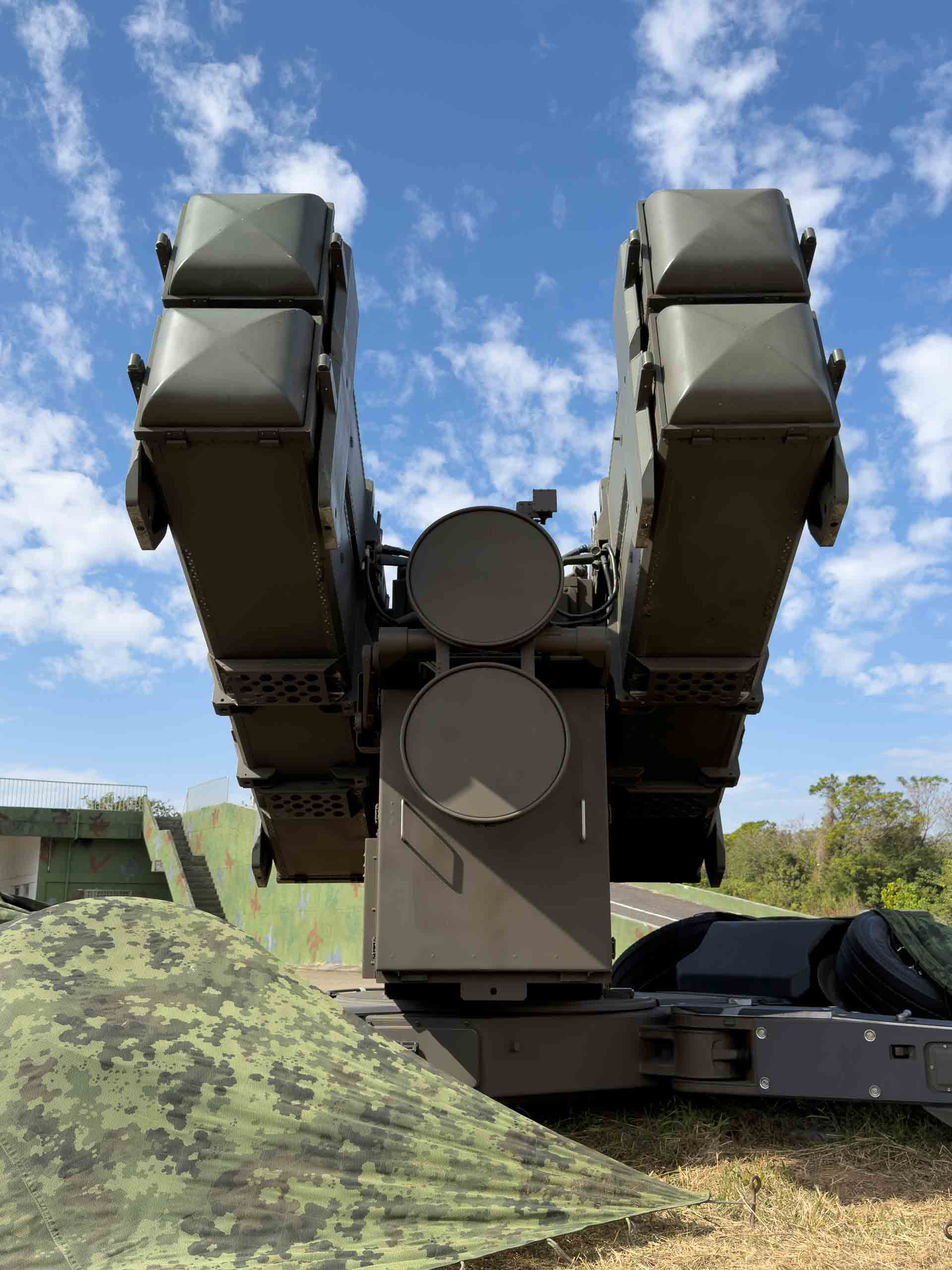
【軍傳媒/軍事專欄】1980年代末期,國軍向美國採購AIM-7麻雀飛彈及其陸射發射器,並整合至「天兵」防空雷達系統之中。該體系以拖曳式射控雷達車為核心,搭配35公厘防空快砲與四聯裝麻雀飛彈發射架,構成彈砲混合的基地要域防空配置,主要部署於機場、油彈庫、指揮所等關鍵固定設施周邊,負責攔截低空飛行的巡弋飛彈與突入近程的空中威脅,成為國軍最後一道防空屏障之一。
一套典型天兵系統,編成包括一輛射控雷達車、兩門35公厘快砲,以及兩具四聯裝麻雀飛彈發射架。由於麻雀飛彈採半主動雷達導引方式,系統必須在終端接戰階段持續以照明雷達照射目標,確保飛彈能接收反射訊號完成導引。此一設計在冷戰末期具備實用性,但在現代戰場環境下,對電子干擾的敏感度與有限的同時接戰能力逐漸浮現;當多批目標自不同方位、高度發動飽和攻擊時,照明與射控雷達的處理能力便成為整體防禦效能的瓶頸。
俄烏戰爭初期,烏克蘭為因應俄軍密集的巡弋飛彈攻擊,向國際社會徵求各型防空裝備。台灣退役的鷹式防空飛彈經美方回購後轉交烏克蘭使用,證明即便是較舊世代的防空飛彈,在面對速度較慢、飛行剖面明顯的巡弋飛彈與無人機時,仍具備實質攔截效能。同時,烏克蘭也大量運用防空快砲與機槍,填補飛彈射界與成本曲線的缺口,凸顯「低成本防空手段」在高強度消耗戰中的不可或缺性。
對國軍而言,現役天兵/陸射麻雀防空飛彈系統正承受兩項結構性壓力,其一是威脅型態的根本改變:現代飽和攻擊已不再侷限於多架有人機,而是結合無人機、巡弋飛彈與誘餌的多批次、多軸線「系統性壓迫」,使仰賴半主動雷達照射的火控模式難以兼顧所有來襲目標。其二則是體系整合與生存性問題:天兵與陸射麻雀皆屬拖曳式系統,雷達、快砲與發射架通常部署於數百公尺範圍內,在機動移防、分散部署與抗偵察、抗打擊能力上,明顯落後於新世代車載、可離散部署、網路化指管的防空系統,這也是國軍規劃以國家先進地對空防空飛彈系統(NASAMS)逐步接替機場等要地防空任務,並在未來數年內汰除包含麻雀飛彈與35公厘快砲在內老裝備的戰略背景。

從成本效益角度觀察,國外資料顯示,海麻雀防空飛彈單發成本約為16.54萬美元,可能陸射麻雀防空飛彈也近似,相較之下,NASAMS的主力彈藥AIM-120 AMRAAM(亦可與空軍空射彈藥共通)單價約在100萬美元左右。僅就彈藥成本而言,舊式陸射麻雀系統確實具備明顯優勢,特別適合承擔「必須攔截、但不宜消耗高價彈藥」的近程防空任務。
不過面對現代飽和攻擊,防空效能的衡量並非單純比較單發價格,而在於有限時間內能否同時處理大量來襲目標並確實擊落。NASAMS的關鍵優勢在於AIM-120 AMRAAM採主動雷達導引,具備射後不理特性,搭配完整的接戰鏈與資料鏈更新能力,可將多目標有效分配給多枚飛彈,顯著降低單一目標長時間占用射控資源的壓力。這使其在理論上更能適應現代飽和威脅,但代價則是每一次攔截的成本顯著上升。國軍規劃採購9套、共339枚NASAMS飛彈,分散部署於北、中、南主要機場,其數量本就相當有限;一旦對手以大量低成本目標誘使防空單位頻繁開火,彈庫存量與預算承受力便可能成為另一種脆弱點,這也是國軍仍必須持續尋求低成本防空手段的根本原因。
在編制與人力層面,一個防空飛彈連由天兵防空快砲與麻雀飛彈系統構成。每具麻雀飛彈發射架編制約七名官兵,涵蓋架長、副班長兼發射架操作手、遙控監視系統(RSU)操作手、電源機操作手、飛彈裝掛手與駕駛等職務;發射架本身配置四枚備射飛彈,操作流程分工嚴謹,發射權限集中於指管體系,發射架操作手主要負責系統檢查與待發狀態維持,小小的空間戰備時只有一個小紅燈,且沒有空調調整溫度,冬冷夏熱還不通風就是個常態,外面的操作人員則暴露在開放環境中,整個防空體系對人力與熟練度的高度依賴,同時也加深操作人員的工作重擔。


以空軍防空部第795旅302營第2連為例,其駐守於台中清泉岡基地,面對軍民兩用機場高密度起降的特殊環境,防砲部隊的任務顯得單純卻極為吃重。官兵平日須透過反覆演練,熟悉麻雀飛彈與35公厘快砲的操作參數、接戰程序與反應節奏;在實戰情境下,防空單位的反應時間極短,任何操作遲疑或錯誤都可能直接影響攔截成敗,因此平時累積的「肌肉記憶」往往決定關鍵時刻的表現。每月的駐地測驗、指揮部不定期測考,以及日夜間對空實彈射擊與各類戰演訓,使防砲部隊長期處於高訓練強度狀態。
未來隨著NASAMS系統陸續成軍,空軍防砲部隊有望透過指管系統網路化、分散部署與主動導引飛彈的特性,降低人力密集操作的需求,將既有兵員進行更有效的配置,緩解兵源逐年下降的壓力。若能同步引進新世代機動防空快砲,或對現役快砲進行升級,進一步降低人力需求並提升攔截效率,強化最後兩公里內的近程防禦層,台灣整體防空體系的完整性與韌性,將有實質性的提升。

In the late 1980s, Taiwan’s armed forces procured the AIM-7 Sparrow missile and its ground-launched firing units from the United States, integrating them into the “Tien-Bing” air defense radar system. Centered on a towed fire-control radar vehicle, the system combined 35 mm anti-aircraft guns with quad-rail Sparrow missile launchers to form a mixed missile-and-gun air defense configuration for the protection of fixed sites. These units were primarily deployed around critical installations such as air bases, fuel and ammunition depots, and command facilities, tasked with intercepting low-altitude cruise missiles and short-range aerial threats. As such, they became one of the final layers in the armed forces’ air defense shield.
A typical Tien-Bing system consisted of one fire-control radar vehicle, two 35 mm anti-aircraft guns, and two quad-launcher Sparrow missile units. Because the Sparrow employs semi-active radar homing, the system must continuously illuminate the target with radar during the terminal engagement phase to allow the missile to receive reflected signals for guidance. This design was practical in the late Cold War era; however, in the modern battlefield environment, its vulnerability to electronic countermeasures and its limited simultaneous engagement capacity have become increasingly apparent. When multiple waves of targets attack from different directions and altitudes in a saturation scenario, the processing capacity of the illumination and fire-control radar quickly becomes a bottleneck that constrains overall defensive effectiveness.
During the early stages of the Russia–Ukraine war, Ukraine appealed to the international community for various air defense systems to counter Russia’s intensive cruise missile strikes. Taiwan’s retired HAWK surface-to-air missiles, repurchased by the United States and transferred to Ukraine, demonstrated that even older-generation air defense missiles can retain tangible interception effectiveness against slower, more conspicuous targets such as cruise missiles and unmanned aerial vehicles. At the same time, Ukraine made extensive use of anti-aircraft guns and machine guns to compensate for missile coverage gaps and cost constraints, underscoring the indispensable role of “low-cost air defense measures” in high-intensity attrition warfare.
For Taiwan’s armed forces, the currently deployed Tien-Bing and ground-launched Sparrow systems face two structural pressures. The first is a fundamental shift in threat profiles: modern saturation attacks are no longer limited to multiple manned aircraft, but instead involve multi-wave, multi-axis “systemic pressure” combining drones, cruise missiles, and decoys. Under such conditions, a fire-control concept reliant on semi-active radar illumination struggles to address all incoming targets simultaneously. The second pressure concerns system integration and survivability. Both the Tien-Bing and ground-launched Sparrow are towed systems, with radars, guns, and launchers typically deployed within a few hundred meters of each other. In terms of mobility, dispersal, and resistance to reconnaissance and strike, they lag significantly behind new-generation vehicle-mounted, distributed, and network-centric air defense systems. This forms the strategic backdrop for Taiwan’s plan to gradually assign base defense missions—such as the protection of airfields—to the National Advanced Surface-to-Air Missile System (NASAMS), while retiring legacy equipment including Sparrow missiles and 35 mm anti-aircraft guns over the coming years.
From a cost-effectiveness perspective, foreign data indicate that a single RIM-7 Sea Sparrow missile costs approximately USD 165,400, suggesting that the ground-launched Sparrow is likely of a similar price range. By comparison, the primary NASAMS interceptor, the AIM-120 AMRAAM—which can also be shared with the Air Force’s air-launched inventory—costs around USD 1 million per missile. Judged purely by munition cost, the legacy ground-launched Sparrow system retains a clear advantage and is particularly well suited for short-range air defense missions where interception is necessary but the expenditure of high-value missiles is undesirable.
However, in the face of modern saturation attacks, air defense effectiveness cannot be measured solely by unit price per missile, but rather by the ability to engage and destroy large numbers of incoming targets within a limited time window. NASAMS’ key advantage lies in the AIM-120 AMRAAM’s active radar seeker and fire-and-forget capability. Combined with a complete engagement chain and data-link updates, the system can efficiently allocate multiple targets to multiple missiles, significantly reducing the burden of prolonged fire-control resource occupation by any single target. In theory, this allows NASAMS to better adapt to modern saturation threats, albeit at a substantially higher cost per interception. Taiwan plans to procure nine NASAMS batteries with a total of 339 missiles, to be deployed across major air bases in the north, central, and southern regions. This inventory is inherently limited; should an adversary employ large numbers of low-cost targets to induce frequent air defense engagements, missile stockpiles and budgetary endurance could become another form of vulnerability. This reality underpins the armed forces’ continued need to seek low-cost air defense solutions.
In terms of organization and manpower, a single air defense missile battery is composed of Tien-Bing anti-aircraft guns and Sparrow missile systems. Each Sparrow launcher is manned by approximately seven personnel, including the launcher chief, deputy squad leader and launcher operator, remote surveillance unit (RSU) operator, power generator operator, missile handling personnel, and driver. Each launcher carries four ready-to-fire missiles, with a rigorously segmented operating procedure and firing authority centralized within the command-and-control structure. Launcher operators are primarily responsible for system checks and maintaining readiness status. The confined launcher compartment offers only a small red indicator light during alert conditions, lacks air-conditioning, and is poorly ventilated—resulting in cold winters, hot summers, and generally harsh working conditions. Personnel operating outside the launcher are exposed to the elements, highlighting the system’s heavy reliance on manpower and operator proficiency, while simultaneously imposing a substantial workload on its crews.
Taking the Air Force Air Defense and Missile Command’s 795th Brigade, 302nd Battalion, 2nd Company as an example, the unit is stationed at Taichung Ching-Chuan-Kang Air Base, a joint civil-military airport with high-density flight operations. In this environment, the mission of air defense gun units is straightforward yet exceptionally demanding. Personnel must repeatedly train to master the operating parameters, engagement procedures, and response tempo of the Sparrow missiles and 35 mm guns. In real combat scenarios, reaction times are extremely short, and any hesitation or operational error can directly determine the success or failure of an interception. As a result, the “muscle memory” accumulated through daily training often proves decisive at critical moments. Monthly base evaluations, unscheduled command inspections, and live-fire exercises—both day and night—combined with various combat drills, keep air defense units under sustained high-intensity training conditions.
Looking ahead, as NASAMS systems are gradually fielded, Air Force air defense units are expected to reduce their reliance on manpower-intensive operations through networked command-and-control, dispersed deployment, and the use of active-guided missiles. This would allow for more efficient allocation of existing personnel and help alleviate pressure caused by a steadily declining manpower pool. If accompanied by the introduction of next-generation mobile anti-aircraft guns or the upgrade of existing systems—further reducing manpower requirements while enhancing interception efficiency and strengthening the final two-kilometer layer of short-range defense—Taiwan’s overall air defense architecture would achieve a tangible improvement in both completeness and resilience.