

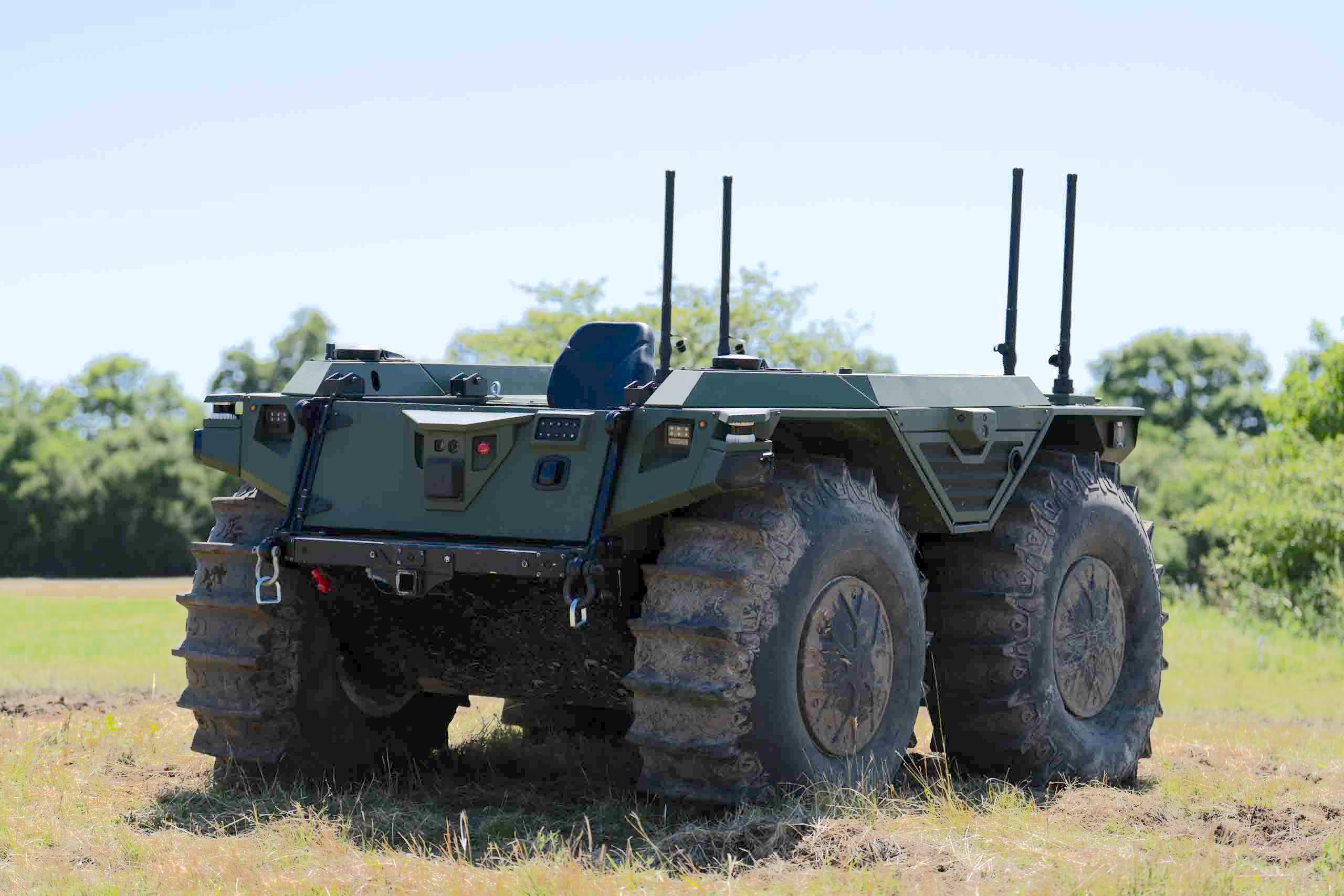
【軍傳媒/國際軍事新聞】在近期世界焦點關注於中東美伊戰爭時,俄烏戰爭仍在殘忍的進行,烏克蘭近日以無人載具作戰,成功完全不秏人力下迫使俄羅斯陣地守軍投降,再次改寫戰場傳說。烏克蘭從「FPV 無人機很便宜、很好用」簡單的不對稱作戰,玩出了新高度新創意。烏克蘭國防部4月公布,僅2026年3月,前線就執行超過9,000次無人地面載具任務;2026年第一季總數接近24,500次,任務涵蓋彈藥運補、後送傷患、前沿支援等,且使用UGV的部隊數量,已從2025年11月的67個單位上升到167個。這代表烏軍不是把機器人當作實驗性裝備,而是把它納入基層部隊日常作戰流程。
烏克蘭總統4月公開說明的影片中,烏軍已展示56種戰時研製且證明有效的武器,其中包括31種各型無人機、6種地面機器人與3種無人水面系統。這說明烏軍當前追求的,不是單項武器突破,而是將空中、地面、海上無人系統變成一種可互補、可量產、可快速迭代的戰場結構。CSIS也指出,烏克蘭的核心目標之一,就是盡可能把作戰人員從最危險的直接接敵區域抽離,改由具部分自主能力的無人系統承擔偵察、打擊與高風險輸送任務,從而消擬掉烏俄之間巨大的人力結構落差。

CSIS在2025年分析中指出,從烏克蘭戰場的實際案例來看,烏克蘭大量導入無人系統,最根本原因之一是要保存有限人力,減少士兵暴露於疲勞、壓力與火力殺傷區之下。2022到2024年之間,烏克蘭在防守和試圖反攻上消耗不少有生力量,對兵力相對有限的一方來說,俄羅斯只要維持這種消耗節奏,烏克蘭遲早會垮掉,因為人力的補充沒辦法靠增加產能的方式來彌補。因此從自殺無人機大量使用開始,以及烏軍用UGV取代人員進入危險地帶運補與後送,等於把最容易被砲兵、FPV與狙擊火力鎖定的工作交給機器處理,這種人力保存模式對烏克蘭來說價值極高,也會直接影響部隊持續作戰能力。
根據RUSI的報告指出,烏軍在2025年曾利用無人機優勢,在前線構築約30公里深的「無人機消耗帶」,對俄軍形成持續殺傷;但俄軍也迅速學會模仿,並把FPV與遊蕩彈藥向近後方延伸。ISW更進一步指出,俄軍學習快速,到2025年利用原本的軍工技術優勢,已開始用戰術型無人機對烏軍地面交通線、集結區、彈藥庫與訓練地實施類似「戰場空中遮斷」的效果。也就是說,無人機不只在壕溝上空盤旋,它已開始扮演傳統有人空軍在戰術縱深內的一部分功能,打擊的同時又減少自身空天軍的實際耗損,在俄烏戰場上,無人機幾乎已經取代了俄羅斯空天軍。
三年的戰爭過去,烏克蘭戰爭讓各國重新認識一件事:即使資源有限的一方,也能靠大量無人系統執行過去只有空軍才能負擔的任務,包括偵察、打擊、局部制空、甚至運輸。這代表傳統以少數昂貴平台為核心的戰力思維,正被「高低混編」取代。昂貴武器依然必要,但若沒有大量可消耗、可快速補充的無人平台,部隊很快會在高密度消耗中被拖垮。對比台灣國防部提出的預算,似乎仍著重在高大尚貴的裝備
烏軍已從早期的「Army of Drones」逐漸走向更成熟的整合運用,但俄軍也在標準化程序、強化學習傳播,雙方正進入彼此模仿、彼此壓制的循環。這意味未來的無人載具部隊不該只是支援單位,而應該是能與步兵、砲兵、工兵、電子戰分隊共同作戰的「合成編組」,烏軍正把無人機、無人地面載具、電子戰、資料鏈與前線後勤整合成一種新型作戰體系。

這次烏軍使用空中無人機偵搜標定、將戰場情勢即時傳給地面無人載具,引導地面載具前推並持續以火力壓制、在無法有效防禦,殺傷進攻烏軍的俄軍守軍被迫棄守或投降。另外的戰場上也有烏軍使用地面無人載具埋伏於俄羅斯陣地後方補給路線上,藉由平時休眠以及利用無人機空投電池的模式,持續保持無人載具運作,成功切斷補給線數週,導致陣地內俄軍士氣崩潰投降的案例。
無人載具的不斷革新,對未來戰爭產生深遠影響。戰場會更加透明化,台灣國防部在2025年《四年期國防總檢討》中也承認,商規偵察衛星、通訊與定位系統普及後,戰場透明度大幅升高,部隊必須更重視隱蔽、偽裝、快速分散與重新集結。而如今加上潛伏的無人載具,例如在印尼被衝上岸的中國無人水下航行器,將使得大型軍艦裝備的調動都將快速被敵方偵知。以目前台灣的能力來說,若左營外圍海域已被解放軍部署無人水下載具潛伏,台灣花大錢做的自製潛艦直接被降維打擊,在可能的威脅下海軍至今仍專注於大軍艦大潛艦,未來戰爭可能早已不是這些將領所想的那樣。
另外由於前線後方的區隔模糊後,補給不中斷將變成勝負關鍵,在大量自主攻擊無人機與遊蕩彈藥之前,地面與防空作戰樣式必須及早因應改變。若無反制無人機體系,任何固定陣地、交通線與灘岸集結點都可能持續被廉價平台消耗。台灣目前的雷達站防禦只有應變小組的一把無人機干擾槍,對超過10公尺外的無人機毫無作用,對於像「見證者」這種等級的自殺無人機更是完全沒有防禦能力,軍方的心態仍維持在用飛彈攔截可能的攻擊。美伊戰爭美軍與伊朗軍事能力即便在不同層次,伊朗都能造成超乎預期的美軍軍事資產損失,一項以美軍馬首是瞻的國軍,如何能說服民眾我們能抵禦類似的攻擊?
台灣最大的軍事威脅「中國」,早已吸收烏克蘭與俄烏戰場的經驗,並利用自身的實力不斷研發出能改變戰場態勢的武器,五角大廈2025年《中國軍力報告》指出,解放軍正持續推進2027目標,並明確把台灣視為核心作戰方向;報告同時指出,解放軍已在訓練中使用可支援兩棲突擊與城鎮作戰的空中、地面無人系統,且其對未來戰爭的理解,包含高科技自主系統、海上封鎖與全域壓制。RAND在2025年的研究也指出,解放軍認為有人—無人協同會是未來作戰的重要特徵,且公開研究已討論在島嶼登陸情境中,以有人戰機搭配多架無人機,穿透防空並在敵防禦區內實施打擊。
台灣到目前為止,防禦的是飛彈洗地、火箭洗地、海峽封鎖、大規模登陸作戰,但中國未必只會用傳統飛彈與兩棲艦艇壓過來,而是為了減少其自身社會衝擊,可能先用大批不同層級的無人系統「清場」。外媒路透社今年引述Mitchell Institute報告指出,中國已將老舊殲-6戰機改造為攻擊型無人機,部署在台海周邊至少六處基地,規模估計達200架以上,目的之一就是在衝突初期用大量低成本平台消耗台灣防空攔截彈。這還只是空中一種選項,並不包括更常見的小型偵察無人機、自殺式攻擊無人機、海上無人艇或登陸支援用的地面機器人。而隨著科技進步,連無人殲六可能都會因為成本太高而廢棄,來襲的是每小時數千架的超低成本無人機,台灣又該如何應對 ?
如果把烏克蘭案例與解放軍現有方向拼在一起,中國對台的無人化運用,大致可能出現在幾個層面。第一,戰前與灰色地帶時期,持續以小型商規或軍規無人機遂行偵搜、電磁測試、目標資料蒐集與心理壓迫。第二,開戰初期,以大量誘餌型、巡弋型與自殺式無人載具配合飛彈,消耗雷達、通訊與防空火力。第三,若進入封鎖或登陸作戰,無人艇、空中攻擊無人機與近岸FPV可能用來壓制港口、灘岸、後方道路與防空陣地。第四,在灘頭或城市戰中,地面機器人可能被用來探路、運補、排雷、送炸藥甚至伴隨步兵穿插。這些判斷不是憑想像,而是與五角大廈、RAND、台灣QDR對解放軍訓練與作戰型態變化的描述相互吻合。

對台灣來說,仍停留在人力遠端遙控的無人載具單位建立這種初步方向,CNAS今年提出的「Hellscape for Taiwan」報告直接吸收烏克蘭戰場教訓,主張台灣應在距岸約80公里到灘岸之間,建立分層、多方向的無人化打擊區。外層以長程空中、海上與水下無人載具消耗船團;中層以水雷與單向攻擊無人機遲滯並導引登陸隊形;近岸最後5公里與灘頭則以短程無人機、攔截無人機、機動防空與火砲密集壓制。這個「讓解放軍無法順利完成登陸 choreography」的防衛能力建立是其一,但在「讓解放軍無法持續不斷以低成本打擊台灣軍民裝備設施」這個部分,卻沒有任何的建樹。
台灣自己的官方文件,2025年QDR明確寫到,無人系統、反無人機系統、AI、通信與資訊安全,是國防創新辦公室的優先項目;該文件同時也指出,大量自主攻擊無人機與遊蕩彈藥已改變地面與防空型態,並要求強化遮蔽、分散、補給持續與通導防護。方向並沒有錯,真正問題在落實的速度、數量、訓練與供應鏈,以及除了被動躲避外的主動防禦模式。
台灣若要真正應對中國的無人大軍威脅,要建立有效嚇阻,前提是取得大量無人系統,且是能結合作戰體系的人工智慧操控系統,而不是靠人力遠端單一遙控。另外,急需建立完整反無人機分層,除了現有的防空飛彈,低成本攔截機動防空飛彈、攔截型無人機、槍砲式反制、誘餌與被動防護等系統都需快速建立。加強無人機高威脅區裝備或關鍵設施的防護,預先部署機動式防禦與假目標。雷達站的防禦空虛就是明顯的案例,雷達是台灣防空之重,如此重要設施對不管是中型自殺無人機、甚至是第五縱隊近距離施放的自殺無人機都無防禦能力,對台灣是極大的警訊。
總結來說,烏克蘭以空地無人化載具攻佔陣地案例清楚展示:誰能把廉價平台、大量生產、快速修正、電子戰抗性、分散式指管與前線補給整合起來,誰就能把人命消耗降到較低,同時把敵軍暴露在持續殺傷之下。烏克蘭已經證明,無人系統可以從偵察兵、投彈手,進一步變成搬運兵、工兵、突擊先導,甚至局部奪控的主角;而中國也正在研究如何把這些經驗轉化為對台作戰工具。對台灣而言,最危險的是仍以零散、單兵器思維應對,代價將非常高昂。

Ukraine’s Unmanned Systems Reach Another Milestone: Capturing Russian Positions Without Human Casualties
While global attention has recently focused on a potential U.S.–Iran conflict in the Middle East, the Russia–Ukraine war continues with relentless intensity. Ukraine has once again demonstrated a new battlefield milestone through unmanned warfare: forcing Russian defenders to surrender and seize positions without risking human assault troops. What began as a simple asymmetric concept—cheap and effective FPV drones—has evolved into a far more sophisticated combat model.
Ukraine’s Ministry of Defense announced in April that frontline forces conducted more than 9,000 unmanned ground vehicle (UGV) missions in March 2026 alone. Total UGV operations in the first quarter of 2026 approached 24,500, covering ammunition resupply, casualty evacuation, and forward support missions. The number of units employing UGVs also rose from 67 in November 2025 to 167. This indicates Ukraine no longer treats robotics as experimental equipment, but as a routine component of frontline warfare.
In a public video released in April, President Volodymyr Zelenskyy highlighted 56 wartime-developed and combat-proven systems, including 31 drone variants, six ground robotic platforms, and three unmanned maritime systems. Ukraine’s objective is no longer a single technological breakthrough, but the creation of an integrated battlefield ecosystem in which air, ground, and sea unmanned systems complement one another, can be mass-produced, and rapidly improved.
Analysts at CSIS have noted that one of Ukraine’s core wartime goals is to remove personnel from the most dangerous direct-contact zones whenever possible. Semi-autonomous systems now perform reconnaissance, strike missions, and high-risk transport tasks, helping offset Russia’s manpower advantage. Between 2022 and 2024, Ukraine suffered heavy personnel losses during defensive operations and attempted offensives. Unlike industrial production, manpower cannot simply be increased on demand. Therefore, replacing soldiers with machines in the most lethal roles has become strategically essential.
RUSI has also reported that in 2025 Ukraine created a drone attrition zone extending roughly 30 kilometers behind frontline positions, inflicting continuous losses on Russian forces. Russia quickly adapted, expanding its own FPV and loitering munition operations deeper into Ukrainian rear areas. ISW further assessed that Russian forces increasingly used tactical drones to attack roads, supply hubs, assembly areas, and training sites, creating a battlefield air interdiction effect once associated with manned airpower.
Three years into the war, Ukraine has shown that even a resource-constrained military can use mass unmanned systems to perform missions once reserved for air forces: reconnaissance, strike operations, localized air denial, and transport. This marks a shift away from dependence on a few expensive platforms toward a “high-low mix” model, combining advanced weapons with large numbers of expendable, quickly replaceable systems.
Ukraine has moved beyond the early “Army of Drones” concept into a more mature combat structure. Drones, UGVs, electronic warfare, battlefield data links, and frontline logistics are now being integrated into combined-arms formations rather than treated as support tools.
In the latest case, Ukrainian aerial drones reportedly identified Russian positions and transmitted real-time targeting data to ground robots. These unmanned ground systems then advanced under covering fire, suppressing defenders who could neither effectively resist nor counterattack. Some Russian troops abandoned their positions or surrendered. In other reported operations, Ukrainian UGVs were hidden near Russian supply routes and kept active through batteries delivered by drones, helping disrupt logistics for weeks until isolated defenders capitulated.
The implications for future war are profound. Battlefields are becoming increasingly transparent. Taiwan’s 2025 Quadrennial Defense Review acknowledged that commercial satellites, communications systems, and navigation technologies have significantly increased battlefield visibility, requiring forces to emphasize concealment, dispersion, and rapid regrouping.
At the same time, hidden unmanned threats are expanding. Chinese underwater drones washing ashore in Southeast Asia suggest that major naval movements may increasingly be exposed through persistent robotic surveillance. For Taiwan, this raises concerns that large warships or expensive submarines could face constant detection and targeting pressure.
Meanwhile, China has clearly studied the Ukraine war. The Pentagon’s 2025 China Military Power Report states that the PLA continues preparations for its 2027 objectives, with Taiwan as a central scenario. The report notes Chinese development of air and ground unmanned systems for amphibious assault and urban warfare. RAND has similarly assessed that manned-unmanned teaming is becoming central to PLA future doctrine.
For Taiwan, the challenge is no longer simply missile strikes, blockade scenarios, or amphibious landings. China may first seek to clear the battlefield with large numbers of low-cost unmanned systems of multiple types. Reuters recently cited research suggesting China converted older J-6 fighters into attack drones, with over 200 positioned near the Taiwan Strait to help exhaust Taiwan’s air defenses in the opening phase of conflict.
The lesson from Ukraine is clear: whoever best combines cheap platforms, mass production, rapid adaptation, electronic warfare resilience, distributed command networks, and frontline sustainment can reduce its own casualties while imposing continuous pressure on the enemy. Ukraine has proven unmanned systems can evolve from scouts and bomb-droppers into transporters, engineers, assault pioneers, and even tools for seizing terrain. China is studying these lessons closely. For Taiwan, the greatest danger would be responding with outdated, fragmented thinking while the character of war has already changed.