

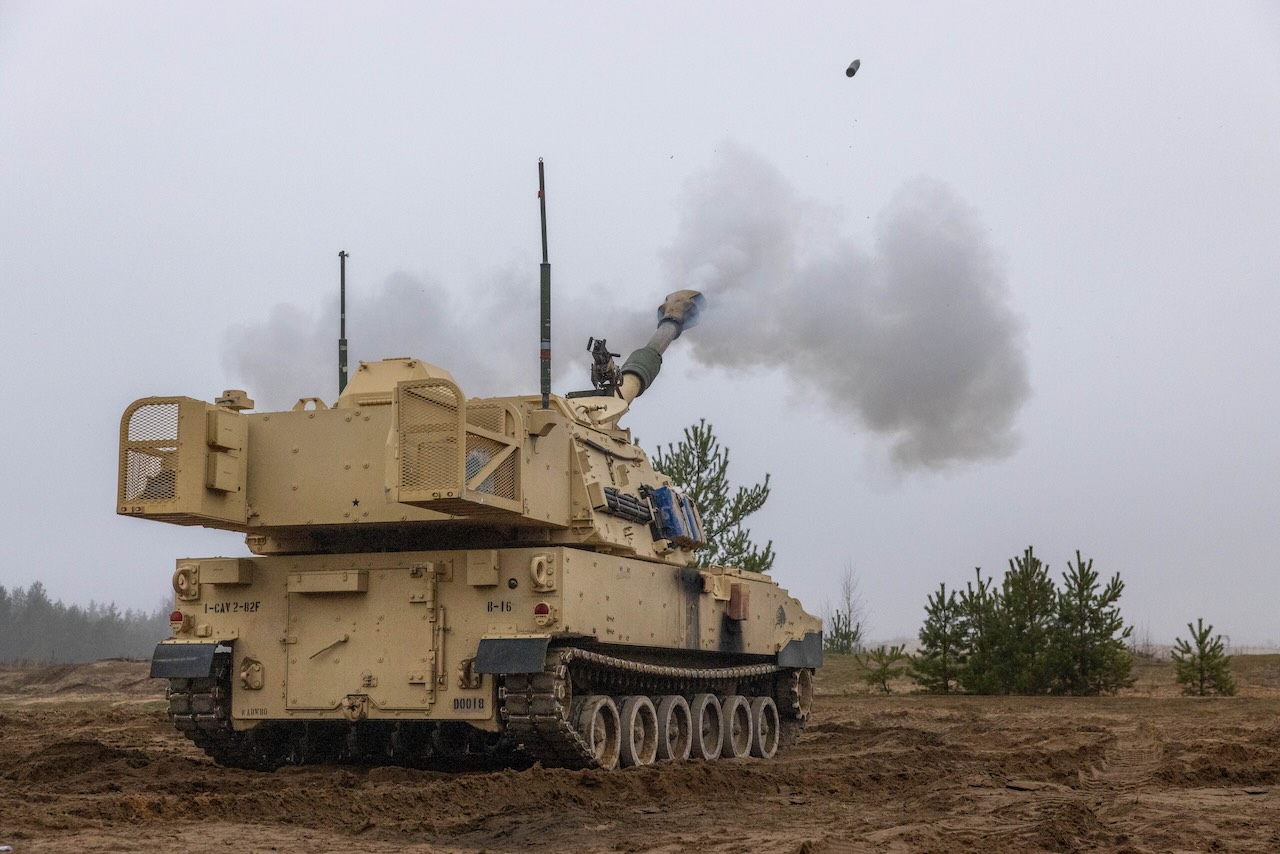
【軍傳媒/軍事科技】M109 系列自走砲是美國自 1960 年代起大量部署的 155 公厘履帶式火砲系統,其設計目的在於伴隨機械化與裝甲部隊行動,提供具備防護能力與高度機動性的間接火力支援。該系列在冷戰期間迅速成為北約與多國陸軍的主力自走砲,並隨著戰場需求演進持續改良。
在歷經 M109A1、A2、A5 等多次升級後,美軍於1990年代後期推出M109A6「Paladin」,首次大幅導入數位化射控與導航系統,之後進一步整合後勤通用性與電子架構的最新量產型,即為M109A7,其於2015年後陸續進入美軍現役部隊,成為目前M109家族的最終主要構型。

台灣陸軍自1980年代起引進M109A2自走砲,正式建立以履帶式自走砲為核心的野戰砲兵體系。相較於傳統牽引式火砲,M109A2在機動性、防護力與持續火力輸出方面具有明顯優勢,使砲兵能有效伴隨裝甲與機械化部隊行動。進入1990年代後,少部分M109A2升級或換裝為M109A5,重點放在延伸射程與改善火砲效能,使其在火力覆蓋範圍上更符合當時的防衛需求。這批 M109A2/A5 長期構成台灣野戰砲兵的主力,並在多次重大演訓中擔任關鍵支援角色。
然而,隨著作戰環境高度資訊化、節奏加快,這些早期型號逐漸顯露結構性限制。其火控流程仍高度依賴人工操作與分段式指揮傳遞,在反應時間、射擊精度與多單位協同能力上,已難以適應現代高強度作戰需求。
M109A7代表新的作戰模式
M109A7相關諸元如下:
- 戰鬥重量:84,000 磅(38,101 公斤)
- 乘員:4 人
- 引擎輸出:675 匹馬力
- 燃油箱容量:145 加侖(549 公升)
- 最高時速:38 英里/小時(61 公里/小時)
- 估計巡航續航距離:186 英里(300 公里)
- 可攀爬坡度:60%
- 側向傾斜能力:40%
- 壕溝跨越能力:72 英吋(1.8 公尺)
- 最大涉水深度:42 英吋(1.07 公尺)
- 全長:382 英吋(9.7 公尺)
- 全寬:155 英吋(3.9 公尺)
- 全高:129 英吋(3.3 公尺)
- 榴彈砲/砲座:M284/M284A2 火砲,M182A1 砲座
- 主發電機:70 kW,600 VDC/28 VDC
- 備用電力容量:大於 50%
M109A7表面上延續M109系列的155公釐39倍徑火砲配置,能使用北約標準彈藥,確保與既有彈藥庫存的相容性,但其更新的真正的關鍵,在於底層架構與作戰流程的全面翻新。
M109A7採用與M2布萊德雷步兵戰鬥車共通的動力、傳動與懸吊系統底盤,使其在可靠度、機動性上顯著優於舊型自走砲,提升戰場存活率,但其新的底盤帶來的後勤負擔將是個隱憂,台灣已有國產雲豹裝甲車,幾無可能再引進M2履帶步兵戰鬥車,因此等於開啟全新的維修負擔,加上新採購的M1A2T戰車,後勤上是必須要重新調整適應。
M109A7內建全數位化火控架構,整合慣性導航、GPS 與戰術資料傳輸能力,使砲車能快速完成定位、接收射擊任務並執行射擊。這代表砲兵單位不再只是「接令後射擊」的被動角色,而是能即時融入整體作戰資訊網路的重要火力輸出單位,若整合成功,過往依靠無線電下令的語音通聯將全面數位化升級,發現到開火的擊殺鏈時間將大幅縮短。
軍售的核心是火砲、火控與指管系統一體化
此次美國對台軍售,包含海馬是多管火箭發射器,並非僅限於M109A7自走砲平台本身,而是明確包含與現代砲兵作戰高度相關的火控與指揮通訊配套,顯示其設計目標是建立完整的數位化砲兵作戰架構。
在指管與通訊層面,軍售案中納入「台灣戰術網路」與「部隊覺知應用套件」,其概念與美軍廣泛使用的戰術指管工具一致,目的在於讓基層單位即時掌握友軍位置、目標資訊與作戰態勢。這使砲兵不再依賴單一路徑傳遞目標,而能在網路化環境中快速完成火力協調。
在火控層面,軍售配套亦包含 International Field Artillery Tactical Data System(IFATDS),以及155公釐彈藥的精準導引套件(PGK)等裝備。IFATDS 是美軍砲兵體系的核心火控系統,負責整合目標資訊、射擊計畫與各砲單位的任務分配,其導入意味著台灣砲兵能在制度與技術層面,向美軍現役砲兵運作模式靠攏。這樣的配套組合,顯示未來M109A7在台灣並非單獨運作,而是作為數位化火力體系中的一個節點,與指揮所、感測單位及其他遠程火力平台相互連結。

對台灣砲兵戰力的實質提升
綜合平台與系統層面的變化,M109A7引進為對台灣砲兵帶來的改變如下:
- 反應速度的縮短:從目標發現、火力指派到實際射擊的時間大幅縮短,使砲兵能在更短窗口內完成打擊,提升對高價值目標的命中與摧毀機率。
- 支援協同能力的提升:透過數位火控與戰術網路,砲兵能更有效與其他兵科(包含陸航的空中支援)、其他火力系統協同運作,避免過往因資訊落差導致的火力浪費或延誤。
- 戰場生存性的提升:更快的射擊準備與轉移能力,使砲兵能降低遭敵方反砲火打擊的風險,符合現代戰場「射後即移」的基本要求。
結語
從 M109A2/A5 到 M109A7,台灣砲兵的變化並非單純的裝備汰舊換新,而是作戰思維與體系的轉型,此次軍售所展現的,不只是引進一款性能更佳的自走砲,而是同步導入火控、指管與通訊配套,讓砲兵真正成為聯合作戰體系中的即時火力節點。
不過這次軍售的項目也間接反映了美方對台海作戰的概念,除了陸軍戰術飛彈外,此次採購的裝備都屬於近程防禦武器,火力覆蓋範圍只有從近岸到灘頭,代表一定程度上美方(或是台灣軍方)認為當台海戰事開啟,台灣必須獨立支撐一定時間,甚至是在本島陸上進行作戰,採購的M1A2T戰車、M109A7自走砲、拖式、標槍反戰車飛彈、自殺無人機等都是符合這種戰場想定;今年開始不斷強調的全民防衛韌性也是如此,台灣土地狹小沒有縱深,一但牽扯陸戰就是在我們的家園旁邊開戰。 從俄烏戰場可以觀之,在當前作戰概念及環境下,砲兵仍是防衛作戰中不可替代的關鍵戰力,不論是以何方式呈現,投彈式及自殺無人機取代瞄不準的迫擊炮,滑翔炸彈取代近接支援;而M109A7的引進,象徵國軍砲兵正式邁向以數位化、網路化與高反應速度為核心的新世代,其影響將遠超過單一武器平台本身,我們樂見國軍不斷向前進步提升戰力,但台灣的國家戰略及防衛戰略也必須清楚及堅定,不然終將成為大國的提款機。

The M109 series is a 155 mm tracked self-propelled artillery system widely deployed by the United States since the 1960s to support mechanized and armored forces with mobile, protected indirect fire. After multiple upgrades, the U.S. Army introduced the M109A6 Paladin in the late 1990s, incorporating digital fire control. The latest variant, the M109A7, entered service after 2015 and represents the final major configuration of the M109 family, emphasizing modern electronics and logistics commonality.
Taiwan introduced the M109A2 in the 1980s and later upgraded part of the fleet to the M109A5 in the 1990s, forming the backbone of its field artillery for decades. While these systems offered advantages over towed artillery, their reliance on manual fire-control procedures and segmented command chains has become increasingly inadequate in today’s fast-paced, information-centric battlefield.
M109A7 Specifications
- Combat weight 84,000 lb (38,101 kg)
- Crew 4 Engine 675 hp
- Fuel tank 145 gallons/549 liters
- Speed 38 mph/61 km/h
- Estimated cruising range 186 miles/300 km
- Slope 60% Side slope 40%
- Trench crossing 72 inches/1.8 m
- Maximum fording depth 42 inches/1.07 m
- Overall length 382 inches/9.7 m Width 155 inches/3.9 m Height 129 inches/3.3 m
- Howitzer/gun mount M284/M284A2 cannon/M182A1 mount
- Main generator 70Kw 600 VDC/28 VDC
- Reserve electrical power >50%
Although the M109A7 retains the 155 mm L/39 gun and NATO ammunition compatibility, its true significance lies in a comprehensive overhaul of platform architecture and operational processes. Sharing automotive components with the M2 Bradley improves reliability and mobility, but also introduces new logistics challenges for Taiwan. More importantly, its fully digital fire-control system—integrating inertial navigation, GPS, and tactical data links—transforms artillery units from passive executors of voice commands into active nodes within a networked combat system, dramatically shortening the kill chain.
The U.S. arms sale to Taiwan is not limited to the M109A7 itself. It includes integrated fire-control and command-and-control systems such as the Taiwan Tactical Network, Team Awareness Kit, IFATDS, and Precision Guidance Kits. Together, these elements aim to establish a comprehensive digital artillery architecture, enabling real-time coordination with sensors, command centers, and other long-range strike assets.
As a result, Taiwan’s artillery gains faster reaction times, improved joint and combined-arms coordination, and greater battlefield survivability through enhanced “shoot-and-scoot” capability. The transition from M109A2/A5 to M109A7 therefore reflects not merely an equipment upgrade, but a fundamental shift in operational concept and force structure.
At the strategic level, the composition of this arms sale—focused largely on short-range defensive systems—suggests an expectation that Taiwan may need to sustain ground combat on its own territory for a period of time. Lessons from the war in Ukraine further reinforce that artillery remains indispensable in modern defensive warfare. The introduction of the M109A7 marks Taiwan artillery’s entry into a new era defined by digitalization, networking, and rapid responsiveness, with implications far beyond a single weapons platform.