

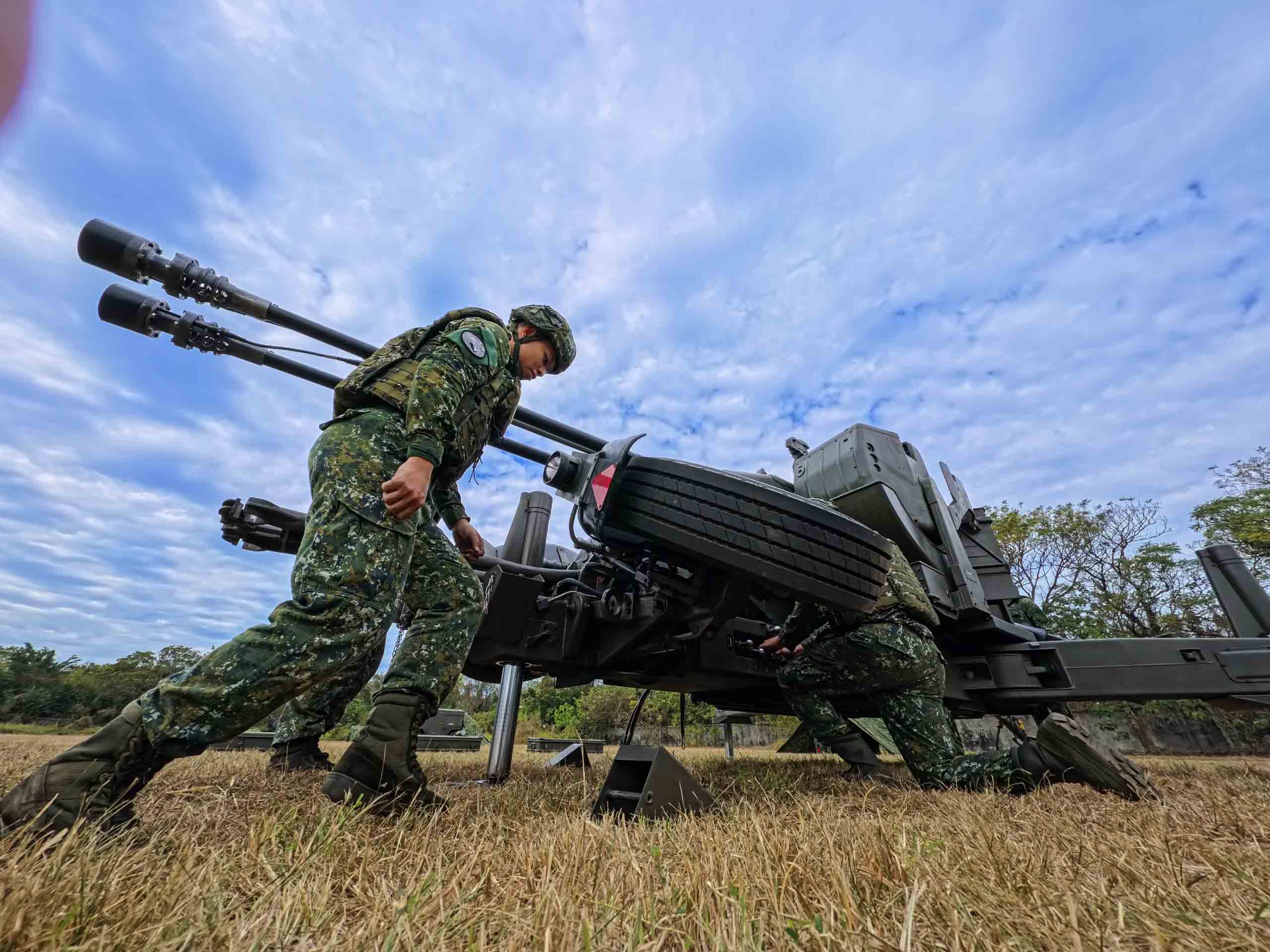
【軍傳媒/從軍我驕傲】在台灣空軍的基地防空體系中,35公厘雙管防空快砲長期存在於雷達、飛彈與戰機光環之外,常被外界視為「老舊但尚未汰除」的裝備。然而從俄烏戰爭開始整個戰爭型態演變與基地防空實際需求來檢視,防空快砲可說是鹹魚翻身,在精準飛彈難以承受消耗戰的條件下,一躍成為不可或缺的末端防空工具。
空軍防空暨飛彈指揮部的核心任務,並不在於擊落多少敵機,而是確保空軍基地在遭受攻擊後,仍具備起飛、維修、補給與指管的基本能力。在現代戰爭中,敵方往往不再執著於殲滅戰機本體,而是以巡弋飛彈、反輻射飛彈、遊蕩彈藥與無人機群,反覆攻擊跑道、機棚、油彈庫與雷達節點,就能使空軍陷入「戰力存在卻無法運用」的狀態,當然若能順道摧毀地面上的空軍戰機直接削弱可用戰力當然更好;烏克蘭就是最佳的示範,利用各式無人機攻擊俄羅斯前線機場油庫、彈藥庫、停在地面的飛機本身,削弱俄羅斯空天軍支援前線及投射空射巡弋飛彈的能量,而在這樣的作戰環境下,基地防空就必須具備低空反應快、可持續射擊、成本可控的防禦手段。

台灣空軍現役的35公厘防空快砲,是在1980年代初購入24台天兵雷達系統與50台GDF-001/002,之後1980年代末期自美國增購AIM-7麻雀飛彈並整合到天兵雷達系統,2009年以30.795億元新台幣實施「天武七號」計劃,將原先的GDF-001/002高射砲升級至可發射AHEAD彈藥的GDF-006,射擊初速達每秒1175公尺,有效射程4公里,最大射程約11公里,最大射高8500公尺,區分電動操作、機械操作2種發射方式,單管每分鐘可發射550發,因此雙管最高射速每分鐘1100發,主要使用彈藥計有高爆燃燒彈、AHEAD彈及訓練用假彈。AHEAD彈內含152顆鎢鋼珠,在距離目標10至40公尺前爆開形成密集破片彈幕,相較一般彈藥具備更高命中率,可有效反制巡弋、反輻射飛彈,更是反制低空無人機的堅實利器。這種「最後一圈防禦」的定位,恰恰是基地防空中最吃緊、也最容易被忽略的一環。
由瑞士奧立岡公司所研發的35公厘雙管防空快砲,有效射程4公里、最大射程11公里,區分電動操作、機械操作2種發射方式,單管每分鐘可發射550發。主要使用彈藥計有高爆燃燒彈、AHEAD彈及訓練假彈。其中,AHEAD彈內含152顆鎢鋼珠,在距離目標10至40公尺前爆開形成碎片破片彈幕,相較一般彈藥具備更高命中率,可有效反制巡弋、反輻射飛彈,更是反制低空無人機的堅實利器。


現行的35快砲並非單獨作戰的武器,其實際戰力來自於搭配的天兵搜索射控雷達,透過雷達導引,快砲能在低能見度、夜間或電子干擾環境下維持接戰能力,同時將目標資訊傳至砲口初速測量器,在砲彈經過時將引信設定資料傳輸至砲彈內引信,使其可以在設定的時間(也就是雷達判定砲彈到達目標附近的時間)來引爆,達到最大殺傷效果。不過若雷達損毀,雖然仍能瞄準射擊,則一切都回到原始機械狀態,當然作戰效率也會大打折扣。
目前國軍的35快砲砲組人員約為7名,包括負責管理人員訓練以及武器彈藥保管維護的砲長、負責射擊的副砲長兼射擊手、左/右方裝填手、兩名彈藥傳遞手、一名電源機操作手,藉由雷達傳輸的資料,射擊手的瞄準具內能顯示目標的距離,同時可以電動搖桿控制火砲的俯仰及轉向,每邊的彈箱可裝56發備彈,由於射速極快,也可預先藉由梁行開關設定留彈量,來限制每次的射擊發數。
自2022年戰爭爆發以來,烏克蘭防空體系高度依賴中長程防空飛彈,成功攔截大量俄軍飛彈與無人機。然而隨著戰事延長,飛彈庫存消耗成為無法迴避的現實問題,曾經有一段時間烏軍的愛國者飛彈用罄。當防空飛彈供應趨緊時,烏軍開始重新大量啟用舊式高射砲、機砲與車載防空火砲,用以對付低空、低速、成本低廉的無人機與巡弋飛彈。

當防空作戰進入消耗戰階段,飛彈就不再適合承擔所有防禦任務,即便攔截成功,單枚高價飛彈換取一架廉價無人機,在戰略層面並不划算。相對而言,防空火砲在彈藥成本、射擊持續性與補給節奏上,更適合承擔「填補飛彈空窗期」與「末端補刀」的角色。35快砲存在價值因俄烏戰爭的實際案例被再次驗證。
然而隨著砲管壽限屆臨、射控電子設備老化,以及整體防空系統現代化需求提升,導致空軍考慮將逐步退役固定式快砲,方向是正確,但目前為止尚未看到新的裝備採購規劃。
國軍35快砲的替代方案,可以參考國外的車載防空砲,能在保留火砲低成本與高射速特性的同時,提升機動性與生存性,避免固定陣地過於容易被定位與壓制、或是結合雷達與自動射控的近迫武器系統(CIWS)防空砲塔,也可能被納入基地防空或重要設施防護的選項。但無論是哪種選項,與各雷達的資訊串聯,減少每個砲組的人力需求、增加自動化偵測與射擊能力、加大備彈庫存,都是必須進步的方向。
在無人化、低成本飽和攻擊成為常態的未來戰場,這種看似傳統、卻極具韌性的防空火砲,反而可能比任何高價系統都更接近戰爭的現實需求。35公厘防空快砲的關鍵並不在於是否「老舊」,而在於是否仍能在整體防空架構中發揮適切功能,只要其射控、感測系統與彈藥、人力需求能隨威脅型態調整改良,在未來的人員編制降低的不可逆情況下,35快砲將依然是基地防空中最務實的一環,它不是用來決定戰爭勝負的明星武器,卻是在威脅逼近時,確保空軍仍能起飛與再戰的最後防線。

Within Taiwan’s air base defense system, the 35 mm twin-barrel anti-aircraft gun has long existed outside the spotlight dominated by radar, missiles, and fighter aircraft. Often regarded as outdated but not yet retired, its operational value has been reassessed in light of the Russo-Ukrainian War and the changing nature of modern conflict. Under conditions where precision missiles are poorly suited for prolonged attrition warfare, gun-based air defense has re-emerged as an indispensable element of terminal base protection.
The primary mission of air base air defense is not to maximize enemy aircraft kills, but to ensure that runways, command facilities, fuel and ammunition depots, and maintenance infrastructure remain functional after attack. Modern adversaries increasingly seek to paralyze air power not by destroying aircraft in the air, but by repeatedly striking ground infrastructure using cruise missiles, anti-radiation missiles, loitering munitions, and low-cost UAVs. Ukraine’s use of drones to attack Russian forward airbases, fuel depots, and parked aircraft demonstrates how air power can be degraded without achieving air superiority.
In such an environment, base defense requires systems that can react quickly at low altitude, sustain continuous fire, and operate at manageable cost—criteria that favor anti-aircraft guns over missiles in the terminal layer.
Taiwan’s Air Force acquired its 35 mm systems in the early 1980s, including Tien-Bing fire-control radars and Oerlikon GDF-001/002 guns. Under the “Tien-Wu Project Phase VII” launched in 2009, these guns were upgraded to the GDF-006 standard, enabling the use of AHEAD ammunition. The upgraded system features a muzzle velocity of 1,175 m/s, an effective range of 4 km, a maximum engagement altitude of 8,500 m, and a combined rate of fire of up to 1,100 rounds per minute.
AHEAD ammunition contains 152 tungsten sub-projectiles programmed to detonate just before reaching the target, creating a dense fragmentation cloud. This significantly improves hit probability against cruise missiles, anti-radiation missiles, and especially low-altitude UAVs. As a result, the 35 mm gun serves as the final and most critical layer of air base defense—often the most stressed and frequently overlooked.
The gun’s effectiveness depends on integration with the Tien-Bing radar system, which enables engagement in low visibility, at night, or under electronic interference. Radar data programs the fuze of each round at the muzzle, ensuring optimal detonation timing. If radar support is lost, the gun can still operate in manual mode, though with reduced effectiveness.
As air defense shifts into an attritional phase, missiles alone are no longer economically sustainable. Exchanging high-cost interceptors for low-cost UAVs is strategically inefficient. Gun-based systems, by contrast, are better suited to filling missile coverage gaps and providing final-layer defense. Combat experience in Ukraine has reaffirmed this role.
That said, aging barrels, obsolete electronics, and broader modernization requirements have led Taiwan’s Air Force to consider retiring fixed-site guns, though no clear replacement plan has yet emerged. Possible alternatives include mobile anti-aircraft gun systems or automated CIWS-style gun turrets, which retain the cost and firepower advantages of guns while improving survivability. Regardless of platform choice, improved sensor integration, greater automation, reduced manpower requirements, and increased ammunition stockpiles are essential.
In a future battlespace dominated by unmanned, low-cost saturation attacks, traditional but resilient gun-based air defense may prove more relevant than expensive high-end systems. The value of the 35 mm anti-aircraft gun lies not in its age, but in its ability to fulfill a practical role within an integrated defense architecture. It is not a war-winning weapon, but the last line of defense that ensures air bases can continue to operate and fight back when threats are already at the gate.