

【軍傳媒/國內軍事新聞】為呈現政府打擊走私與反毒工作的成果,海洋委員會海巡署偵防分署上週於海巡署鎮海樓 6 樓舉辦「海巡署偵防分署查獲新正和 168 貨輪走私毒品聯合記者會」。記者會除海洋委員會管碧玲主委蒞臨現場外,法務部鄭銘謙部長及內政部吳堂安常務次長也蒞臨現場共襄盛舉。現場除展示基隆查緝隊查緝 333 公斤大麻成果之外,特勤隊也展現查緝行動所使用的武器裝備。
根據資料,去年海巡署總共查獲1萬3,397公斤各級毒品,今年光第一季已經查獲4,858公斤,顯見毒品危害逐年增加,而海巡是台灣防堵查緝的第一線。

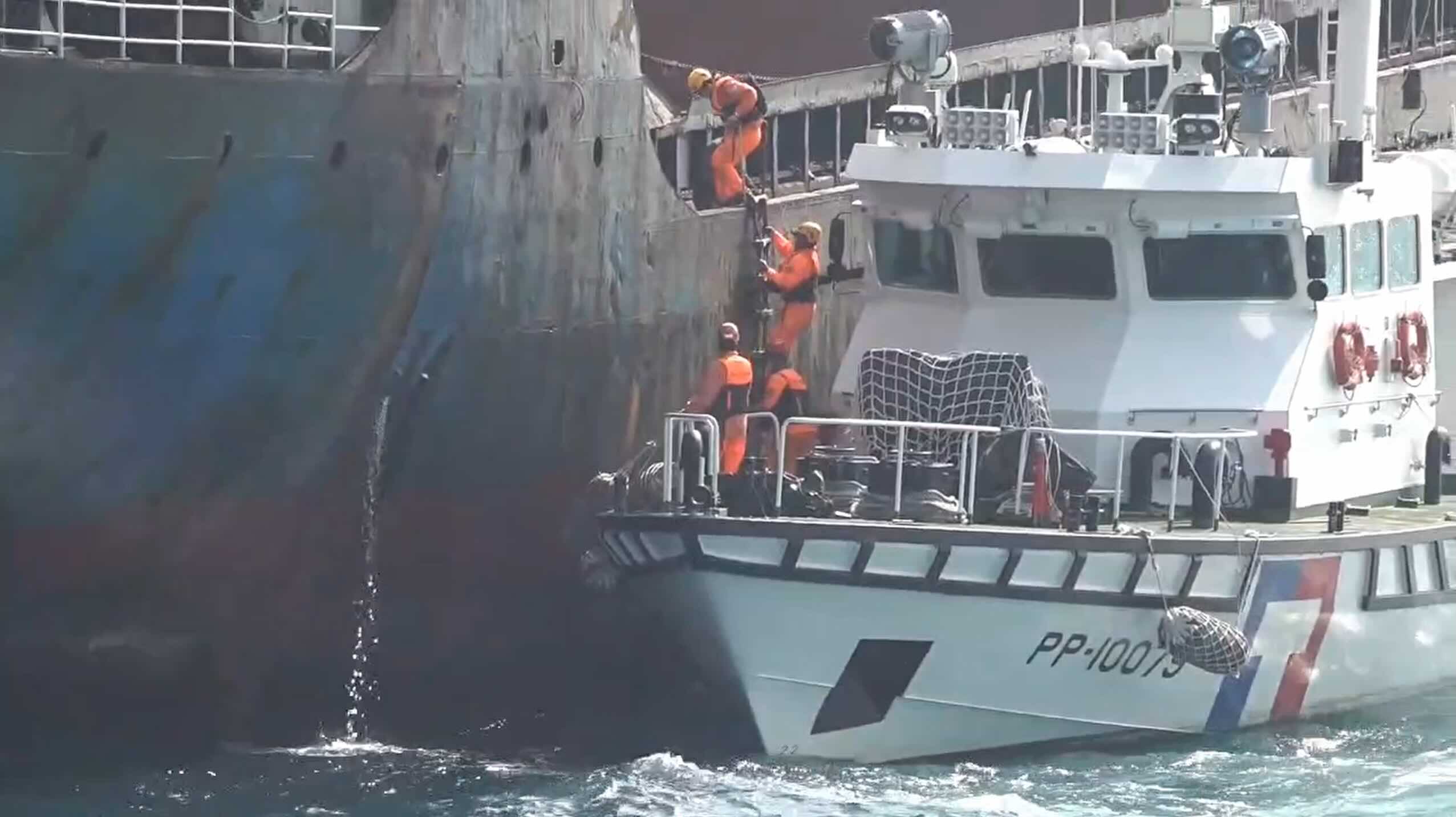
記者會主要展示去年12月2日基隆查緝隊接獲跨國情資,有船舶於北部海域從事不法活動,旋即報請臺灣基隆地方檢察署指揮偵辦,並會同海洋委員會海巡署艦隊分署第二、第十、第十二海巡隊、偵防分署特勤隊及空中作業隊等單位,以及新北市政府警察局海山分局、內政部警政署臺中港務警察總隊成立專案小組,發現「新正和 168 號」貨輪AIS顯示中華民國船隻,船尾懸掛馬來西亞國旗,明顯違法,且船隻行動邏輯與一般不同,海巡艦艇靠近欲登檢時便加速蛇行逃逸拒檢,在海巡特勤隊發射9發震撼彈、4發攻堅照明彈、10發槍口聲爆彈共23發非致命彈藥後,才在彭佳嶼附近海域順利登檢「新正和 168 號」貨輪,成功查獲大批第二級毒品大麻花,總重約 333.507 公斤。
此案犯嫌包含船長及船員共7名均為中國籍,管主委表示此案查緝過程中不斷受到來自對岸的壓力,全案依違反毒品危害防制條例移送臺灣基隆地方檢察署偵辦。管主委接著說,海巡署秉持「三安:國安、治安、平安」及「溯源斷根」之精神,落實「五打七安」政策主軸,深化與檢、警、調及關務等各機關合作,精準打擊不法與應處灰色地帶威脅,全面維護海域安全。

這次攔檢照例是由海巡特勤隊打頭陣,第一個跳上攔檢船隻,中華民國海巡特勤隊(CGA Special Task Force)成立於 2005年7月1日,隸屬於海洋委員會海巡署偵防分署,目前駐守在桃園,成員來自於海巡人員主動申請,最近展開第17期新進人員訓練。由於海巡特勤隊許多任務是要在海上執勤,因此訓練時也會特別強調水性,基本的要求是潛泳要50公尺不換氣,且每位隊員都要有小艇操作執照,當然基本的體能要求也都比照其他特勤隊的標準。
要進行海上任務前,海巡特勤隊都會評估整體環境狀況,看是以哪種方式風險最低,包括海巡艦艇並行靠泊、突擊小艇登船、或是直升機垂降等不同方式登船,由於海上狀況多變,浪差甚至有可能高達數十公尺,因此登船風險其實超高。
而要達成任務,也要有好的裝備支持。現場展示的模組化登船梯以碳纖維製成,前面可搭配不同的碳纖維爪鈎以固定在不同船舷,再以可伸長的繩梯登船,繩梯才一個手掌寬,在海上晃動的環境要順利安全上船並非一般人想像中簡單。
每次任務依照不同的內容,會組成4-8人的攻堅小隊,並搭配狙擊手、無人機飛手等,而由於任務風險高,海巡特近期也更換新型戰術背心,除了前後的加強防彈板可以抵擋5.56鋼芯彈之外,也縮小整體面積方便手臂的活動,在狹窄的船艙空間中更合適,同時具備抗腐蝕、防鏽、防水,且能抵抗魚刀魚叉等銳器刺穿。而浮力氣囊也改成附加式,在陸地任務中可以移除減輕重量及磨耗,需要時再加上掛於兩側腰上,遇水自動展開撐住腋下,在人員昏迷時仍能維持全裝人員浮於水上。

至於其他裝備,除了前面的榴彈發射器發射不同的非致命彈藥外,主要長槍是以MK-18突擊步槍、M4S90霰彈槍以及Glock-17手槍為主。在查緝毒品上則以手持式X光機、手持式拉曼、二合一光譜儀等。二合一光譜儀可以識別不同的化學及爆炸物質,內部資料庫有1萬4,768筆,搭配紅外線二合一光譜儀可以針對新興毒品及先驅物做快速篩檢,手持式拉曼內部資料庫有1萬8,540筆,重量才1.8公斤,可執行非破壞性穿透檢測。另外手持式X光機可以再複雜的船艙通道中確認隱匿入口以及藏物處後,再執行破壞性封鎖,彌補人工查艙之不足及降低賠償風險。
這次的查緝任務長達30個小時不間斷,海巡人員的辛苦非外界想像,一般海巡艦艇人員除了底薪之外、海上勤務加給、警勤加給、專業加給、海勤加給以及加班費,海巡特勤隊人員則多了特勤加給,乍看之下很多,但考慮其整體工作時長及在海上的特殊環境,以及近年對岸灰色襲擾次數大幅增加,相關人員的辛苦不在話下,管主委上任後,實際落實對基層的照顧,爭取許多預算,包含裝備的更新、艦艇的增加、人員的照顧都大幅改善,也有適當的行銷讓外界更了解海巡的辛苦,這次記者會的毒品查緝成果,以及近期社會越來越多的毒品事件,顯示各種威脅仍逐年增加,仍須全民一起努力。

Taiwan Coast Guard Demonstrates Maritime Enforcement Capabilities in Joint Anti-Smuggling Operation
To highlight the government’s efforts in combating drug trafficking and smuggling, the Investigation and Prevention Branch of Taiwan’s Coast Guard Administration (CGA) held a joint press conference last week at its headquarters. The event showcased the successful interdiction of the cargo vessel Xin Zheng He 168, which was found carrying a large quantity of illegal drugs. The conference was attended by Ocean Affairs Council Minister Kuan Bi-ling, Minister of Justice Cheng Ming-chien, and Deputy Minister of the Interior Wu Tang-an, underscoring the importance of interagency cooperation in tackling transnational crime.
During the event, authorities displayed 333 kilograms of seized cannabis, intercepted by the Keelung task force, along with operational equipment used by the CGA Special Task Force. According to official statistics, the CGA seized a total of 13,397 kilograms of narcotics last year, and 4,858 kilograms in the first quarter of this year alone, indicating a rising trend in drug-related threats. As Taiwan’s first line of defense at sea, the Coast Guard plays a critical role in intercepting illicit trafficking before it reaches shore.
The operation began on December 2 last year, when the Keelung task force received international intelligence indicating suspicious maritime activity in northern waters. Under the direction of the Keelung District Prosecutors Office, a joint task force was formed, integrating multiple CGA units—including fleet divisions, special operations teams, and aerial support—along with local police and port authorities.
Investigators identified the vessel Xin Zheng He 168, which presented conflicting signals: its Automatic Identification System (AIS) indicated a Taiwanese vessel, while it flew a Malaysian flag. Its irregular movements further raised suspicion. When CGA vessels approached for inspection, the ship attempted to evade interception by accelerating and maneuvering erratically. Only after the Special Task Force deployed 23 non-lethal rounds—including flashbangs, illumination rounds, and acoustic deterrents—was the vessel successfully boarded near Pengjia Islet. Authorities subsequently seized approximately 333.5 kilograms of cannabis.
Seven suspects, including the captain and crew, were arrested, all of whom were Chinese nationals. Minister Kuan noted that the operation faced pressure from across the Taiwan Strait, highlighting the complex nature of cross-border law enforcement. The suspects were transferred to prosecutors under Taiwan’s Narcotics Hazard Prevention Act. She emphasized that the CGA remains committed to safeguarding national security, public safety, and social stability, while strengthening interagency cooperation to address both criminal activities and gray-zone threats.
The boarding operation was led by the CGA Special Task Force, an elite unit established in 2005 and based in Taoyuan. Members are selected from within the Coast Guard and undergo rigorous training, including advanced swimming requirements such as a 50-meter underwater swim without breathing. All personnel must also be certified in small-boat operations, in addition to meeting high physical fitness standards.
Before each mission, the task force evaluates environmental conditions to determine the safest boarding method, which may include parallel vessel approach, fast-boat insertion, or helicopter rappelling. Given the unpredictability of sea conditions—where wave heights can be extreme—boarding operations carry significant risk.
To support these missions, specialized equipment is essential. The task force employs modular carbon-fiber boarding ladders equipped with interchangeable grappling hooks to secure onto different hulls. These are paired with narrow rope ladders, requiring exceptional balance and skill to climb in unstable maritime conditions.
Operational teams typically consist of four to eight members, supported by snipers and drone operators. Personnel are equipped with newly upgraded tactical vests that provide enhanced ballistic protection while allowing greater mobility in confined shipboard spaces. These vests are corrosion-resistant, waterproof, and capable of resisting punctures from sharp weapons such as knives or spears. Detachable flotation devices can be added for maritime missions, automatically inflating in water to keep personnel afloat even if unconscious.
Standard equipment includes MK-18 rifles, M4S90 shotguns, and Glock 17 pistols, alongside non-lethal launchers. For drug detection, the unit uses handheld X-ray devices, Raman spectrometers, and dual-mode analyzers capable of identifying thousands of chemical substances. These tools enable both non-destructive inspection and precise detection in complex ship environments, reducing operational risks.
The mission lasted over 30 continuous hours, reflecting the demanding nature of Coast Guard operations. While personnel receive various allowances for maritime and specialized duties, the workload and risks remain substantial, especially amid increasing gray-zone pressure in recent years. Since taking office, Minister Kuan has worked to improve conditions for frontline personnel, including equipment upgrades, fleet expansion, and enhanced welfare support.
This successful operation, along with the rising number of drug-related cases, highlights the growing scale of maritime threats. It underscores the need for continued vigilance, interagency coordination, and public awareness to effectively safeguard Taiwan’s maritime security.