

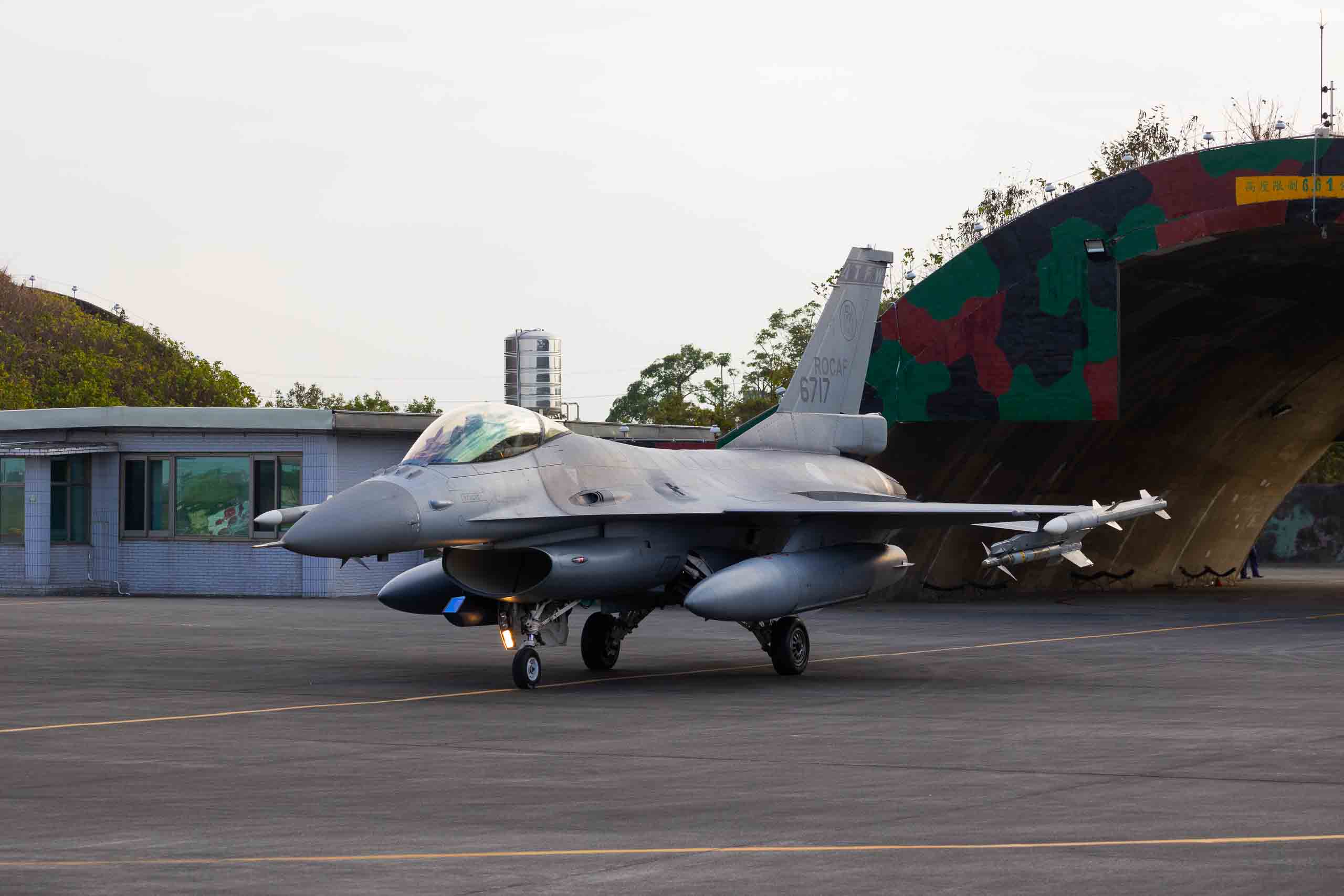
【軍傳媒/國內軍事新聞】農曆新年將至,在國際軍事緊張態勢持續升溫的情勢下,國防部日前於1月27日至29日舉辦「國軍115年春節加強戰備媒體邀訪活動」,以開放式媒體採訪,讓社會大眾更直接了解國軍官兵於春節期間強化戰備整備、快速反應、陸海空整體聯合作戰訓練之成果與決心。此次媒體邀訪活動涵蓋陸軍、空軍、海軍操演實況,空軍部分分成兩天舉行,重點放在空軍防空武器裝掛與F-16V戰機緊急起飛演練,以及三五快砲與麻雀飛彈防空聯合演練。


空軍戰備緊急起飛開場
春節前夕,空軍司令部率隊在嘉義基地開啟兩日連續邀訪行程。現場媒體首站抵達空軍第四戰術戰鬥機聯隊停機坪,在地勤與飛行官的引導下,親眼目睹F-16V戰機緊急起飛操演過程。
基地警戒室突如其來的警鈴與紅色警示燈,標示著一個模擬緊急狀況的啟動,空軍「全天候戰備警戒」演練正式開始。飛行官與地勤人員迅速奔赴機庫,在限定時間內完成裝備穿戴、戰機發動、系統校準與導航儀器設定等一連串繁重程序。空軍需要24小時保護領空,因此也是全天候待命,在待命室中飛行員已穿戴好抗G服與相關裝備,並將頭盔預置於座艙內,待命機也以整備好處於隨時可以啟動引擎起飛的狀態,基本對空武器(2枚AIM-120及2枚AIM-9飛彈)及副油箱已掛載及加滿油,以縮短緊急情況的反應時間。
當起飛前檢查完成,起飛命令下達,兩架飛機一前一後滑入跑道,通常長機會攜帶神射手莢艙用以遠距監控,僚機則負責掩護。根據空軍飛行員透露,飛行時同時要操控莢艙感測器鎖定敵機,以及其他飛行操作,若不熟練的確會手忙腳亂,這也是空軍訓練不能中斷的原因。兩架戰機於跑道頭接獲起飛許可後,飛行員推進油門加足馬力,時值傍晚,可見發動機噴嘴產生耀眼火焰與馬赫環,伴隨轟隆巨響戰機迅速升空,這不僅是視覺效果的震撼,更是軍方宣示全天候守護我國空域安全能力的具體證明。


機場防空核心:35快砲與麻雀飛彈
媒體第二日的重點則轉往空軍嘉義基地另一區域,進行陸基短程防空系統(35mm快砲)與麻雀飛彈發射架的防空演練講解與實操示範。
在接獲防空攔截命令時,營區會由安全士官敲鐘或鳴警鈴以示警,待命官兵須迅速跑到砲位就位並展開戰備準備,此時除了武器裝備就位外,砲組其餘非操作快砲的兵員也須守護陣地安全。首先會透過天兵雷達、35快砲與麻雀飛彈發射架之間的通聯系統檢查,確保各相關裝備間通信與控制功能正常,隨後模擬上彈程序,以1:1的新式紫頭模擬彈來演練。戰鬥過程中,雷達操作手將雷達系統探測到的資訊傳到火砲與飛彈架,導引火砲彈藥做精準射擊。
受訪的連長邱耀廷少校指出,單位平時每月透過駐地訓練與成效驗收來檢視官兵訓練成果,並透過春節前的「立即戰備操演」進一步提升官兵的自信與警覺性。他強調,演練不只是示範操作,更是鍛鍊面對突發狀況的處置能力。
目前國軍的35快砲使用的均為AHEAD彈藥,可在距離目標約40至60公尺處爆炸,發射出數百顆鋼珠形成密集彈幕,有效攔截高速或小型目標,對低空突襲機與巡弋飛彈具有高度反制能力,能有效保障機場與防空陣地安全。不過缺點就是一定要有雷達的導引,如果天兵雷達被破壞,則35快砲就會返回二戰時期以光電瞄具直接瞄準射擊。
談到「彈砲合一」短程防空系統與純飛彈防禦系統的差異時,他指出飛彈系統多用於對付較遠目標,而麻雀飛彈有效距離2至16公里;35快砲約4公里,可攔截突破遠程防空網的近距離威脅,形成多層防護網。
對於無人機的威脅,針對大型及遠程攻擊型無人機,只要被雷達捕獲,並在攔截的範圍內,35快砲就可直接實施有效射擊。這一點在近年高頻度無人機威脅情勢下尤其重要。然而天兵雷達系統畢竟已經有一定年紀,若能搭配雷達及火控更新,裝備本身仍能在攔截無人機上發揮很好的效用,俄烏戰場上流出烏克蘭使用重機槍擊落俄羅斯見證者(Shahed-136/131)無人機的影片,顯示傳統防空快砲對於慢速低飛的無人機仍有足夠的殺傷力。


在示範結束後,官兵並進行了對空搜索與目標捕獲演練,雷達先行搜索目標,其後引導快砲與麻雀架進行接戰。整套程序不僅顯示出系統間的整合性,也展現了部隊快速反應與即時應對的能力。
作為天兵雷達操作手的排長莊立得中尉,負責PPI介面監控目標與識別任務。他指出天兵雷達最大搜索距離約22公里,能在目標進入範圍內即時顯示捕獲與敵我識別資訊。經識別後,雷達會計算距離與速度等數據,提供分配給麻雀飛彈或三五快砲的決策依據,不過最終決策仍由雷達操作人員決定。
面對來自共軍較新型無人機威脅,莊中尉指出,3.5快砲改良後可加裝初速測量器,搭配AHEAD彈藥,可在距離目標約40至60公尺處爆炸,發射出數百顆鋼珠形成密集彈幕,有效攔截高速或小型目標。
近年來,中共軍機與相關軍事活動頻繁擾動臺海周邊空域,國防部已多次表達必須維持高標準戰備與整體作戰能力。面對不確定威脅,空軍以全天候警戒、快速反應與多層防空系統結合,作為守護空域安全的基礎,透過這次媒體邀訪,空軍在裝備整合與人員協同操作之間的精密協調,無論是F-16V戰機緊急起飛,或是短程防空火力的快速備戰部署,背後是長期不間斷訓練、制度化流程與官兵堅定的守護意志。春節本是闔家團圓時刻,國軍仍以「絕不鬆懈戰備警戒」回應時局挑戰,以實際行動詮釋對國土安全的最高承諾。


Lunar New Year Enhanced Readiness Media Event Amid Rising Regional Tensions
As the Lunar New Year approaches amid escalating international military tensions, Taiwan’s Ministry of National Defense held the “ROC Armed Forces 115th Lunar New Year Enhanced Readiness Media Event” from January 27 to 29. Through open media access, the event allowed the public to gain direct insight into how service members strengthen readiness, maintain rapid reaction capabilities, and conduct integrated joint operations across land, sea, and air during the holiday period.
The media program covered live training activities by the Army, Air Force, and Navy. The Air Force portion was conducted over two days, focusing on air defense weapons loading procedures, F-16V emergency scramble drills, and integrated air defense exercises involving 35mm anti-aircraft guns and Sparrow missile systems.
Air Force Emergency Scramble Demonstration
Ahead of the Lunar New Year, the Air Force Command led a two-day media visit at Chiayi Air Base. The first stop brought reporters to the flight line of the 4th Tactical Fighter Wing, where they observed an F-16V emergency scramble exercise under the guidance of flight and ground crews.
A sudden alarm and flashing red warning lights from the base alert center signaled the initiation of a simulated emergency, marking the start of an “around-the-clock combat readiness” drill. Pilots and ground personnel rushed to the aircraft shelters, completing equipment checks, engine start-up, system calibration, and navigation setup within strict time limits.
Because the Air Force must safeguard national airspace 24 hours a day, pilots remain on continuous standby, already wearing G-suits with helmets pre-positioned in the cockpit. Alert aircraft are fully fueled, armed with basic air-to-air loads—two AIM-120 and two AIM-9 missiles—and equipped with external fuel tanks to minimize response time.
Once pre-flight checks were completed and takeoff clearance granted, two aircraft taxied onto the runway in sequence. Typically, the lead aircraft carries a Sniper targeting pod for long-range surveillance, while the wingman provides cover. Pilots noted that simultaneously managing pod sensors and flight operations requires constant training to avoid task overload.
As the fighters advanced throttles at dusk, engine exhaust produced bright flames and visible Mach diamonds, accompanied by a thunderous roar as the aircraft rapidly lifted off—an unmistakable demonstration of the Air Force’s capability and resolve to defend Taiwan’s airspace at all times.
Airport Air Defense: 35mm Guns and Sparrow Missiles
On the second day, media attention shifted to another area of Chiayi Air Base for demonstrations of short-range ground-based air defense systems, including 35mm anti-aircraft guns and Sparrow missile launchers.
Upon receiving an air defense alert, security personnel sound alarms to signal the unit. On-duty troops sprint to their assigned positions, preparing weapons and securing the perimeter. Initial procedures include system checks linking the Tien-Bing radar with the 35mm guns and Sparrow launchers to ensure proper communication and fire-control functionality. Live-fire procedures are simulated using 1:1 inert training rounds.
During engagements, radar operators transmit target data to the guns and missile launchers, enabling precision fire control. Major Chiu Yao-Ting, the unit’s commanding officer, explained that monthly garrison training and evaluations are used to assess readiness, while pre-holiday immediate-readiness drills enhance confidence and situational awareness. He emphasized that exercises are not merely demonstrations, but critical preparation for real contingencies.
The 35mm guns currently employ AHEAD ammunition, which detonates approximately 40 to 60 meters from the target, releasing hundreds of tungsten sub-projectiles to create a dense kill zone. This makes the system highly effective against high-speed or small targets, including low-altitude aircraft and cruise missiles. However, the system depends heavily on radar guidance; if the Tien-Bing radar were disabled, the guns would revert to optical aiming, similar to World War II-era methods.
Discussing the integration of gun-missile air defense systems versus missile-only defenses, Major Chiu noted that missiles are better suited for longer-range threats—the Sparrow missile has an effective range of 2 to 16 kilometers—while the 35mm guns cover roughly 4 kilometers, intercepting close-range threats that penetrate outer defenses and forming a layered protection network.
Regarding unmanned aerial threats, the 35mm guns can effectively engage large or long-range attack drones once detected by radar and within engagement range. This capability has become increasingly important given the growing frequency of drone threats. Although the Tien-Bing radar is aging, upgrades to radar and fire-control systems could significantly extend its effectiveness. Footage from the Russia-Ukraine war showing Ukrainian forces using heavy machine guns to shoot down Shahed-136/131 drones demonstrates that traditional anti-aircraft weapons remain lethal against slow, low-flying UAVs.
Following the demonstration, troops conducted air search and target acquisition drills, with radar detection guiding engagements by both guns and Sparrow launchers. The process showcased system integration as well as the unit’s rapid response and real-time engagement capability.
Second Lieutenant Chuang Li-Te, a platoon leader and Tien-Bing radar operator, explained that the radar has a maximum detection range of approximately 22 kilometers and provides real-time tracking and friend-or-foe identification. After classification, the radar calculates speed and distance data to support decisions on assigning targets to Sparrow missiles or 35mm guns, though final engagement decisions remain with radar operators.
Addressing newer PLA drone threats, Lt. Chuang noted that upgraded 35mm guns equipped with muzzle velocity sensors and AHEAD ammunition can detonate near targets, releasing dense fragmentation to effectively intercept small or fast-moving threats.
Constant Vigilance During the Holiday Season
In recent years, Chinese military aircraft and activities have increasingly challenged airspace around Taiwan, prompting the Ministry of National Defense to emphasize the need for sustained high-level readiness and integrated combat capability. In response to uncertain threats, the Air Force relies on round-the-clock alert status, rapid reaction, and layered air defense systems as the foundation of airspace security.
Through this media event, the Air Force demonstrated precise coordination between equipment integration and personnel operations—from F-16V emergency scrambles to rapid deployment of short-range air defense assets. Behind these capabilities lie continuous training, standardized procedures, and the unwavering commitment of service members.
While the Lunar New Year is traditionally a time for family reunions, the Armed Forces reaffirmed their resolve to maintain unwavering readiness, translating their commitment to national security into concrete action and demonstrating the highest level of dedication to defending Taiwan’s territory.