

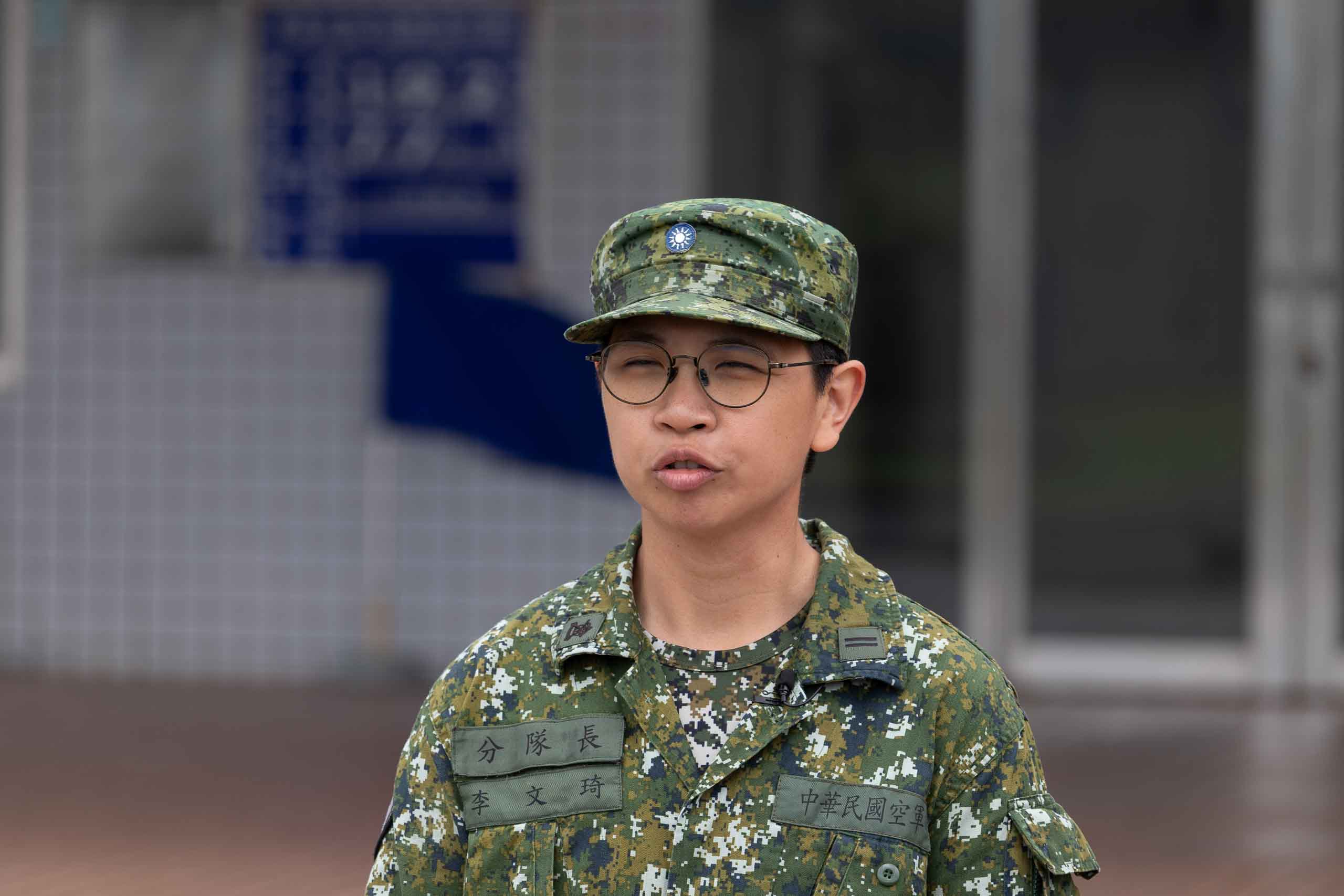
【軍傳媒/從軍我驕傲】憲兵十二中隊中尉分隊長李文琦,出身南部高雄家庭,六年前自專業軍官班畢業時正值疫情期間。在當時整體就業環境充滿不確定性的背景下,她選擇投身國軍體系,追求穩定且具發展性的職涯。身為家中長女,其父親任職於公務體系,對於工作的穩定性有深刻理解,雙親對她的選擇亦給予高度尊重與支持。
完成訓練後,李文琦分發至空軍憲兵單位服務。由於當時只有北部單位有職缺,她先於憲兵指揮部所屬單位服役,後續轉調至石門分隊。相較於台北市區憲兵單位以高頻率維安勤務為主,石門分隊的任務型態則以營區安全防護為核心。過去在首都執勤期間,無論總統或副總統行程,憲兵皆須投入安全維護任務;而現階段駐守於石門,雖然任務性質相對單純,卻需長時間面對地形偏遠、環境較為荒涼的駐地條件,由於雷達設施多位於山頂或濱海地帶,對人員適應力與警戒能力皆是一大考驗。


石門分隊的核心任務在於應對突發狀況。當營區進入緊急應變狀態時,會以警鐘作為集結信號,一分鐘待命班需在極短時間內完成武器與裝備的領取,迅速前往指定位置處置狀況。這種高時效的應變機制,仰賴平時反覆演練與高度紀律,確保在突發事件發生時能即刻投入行動。
面對近年逐漸升高的無人機威脅,單位亦建立標準化應對流程,區分為辨識監視、告警、安全警示與處置行為四個階段。現階段仍以目視偵測為主要發現方式,在採取步槍射擊等硬殺手段,或使用干擾槍進行軟殺前,緊急應變人員會先行通報營區單位,確保後續行動具備協調性與安全性。此一流程反映出現行防護體系仍處於由傳統警戒向反無人機作戰轉型的過渡階段。

在日常勤務與訓練方面,由於任務需求,官兵多以全副武裝狀態執行營區防護,同時將其納入日常訓練內容。除基本體能維持外,也透過重量訓練強化負重能力,並配合駐地定期測驗,確保人員在高強度勤務下仍具備穩定表現。雖然單位編制規模不大,且採取24小時輪值制度,但在任務性質相對明確的情況下,官兵間反而有更多時間培養默契與團隊凝聚力,對整體戰備效能形成正向支撐。
目前緊急應變班配備的無人機干擾槍為 DronesVision 系統,重量約2公斤,採單電池設計,於民國109年接裝。該裝備主要針對2.4GHz與5.8GHz頻段進行干擾,在面對現代無人機多頻段、甚至自製改裝機種時,其效能已逐漸顯現限制。對於採用特殊頻段或非標準通訊方式的目標,現有裝備可能難以有效壓制,顯示反無人機能力仍有提升空間。


From Capital Security to Base Protection: The Evolving Role of a Military Police Squad Leader
Second Lieutenant Li Wen-chi, a squad leader in the 12th Military Police Company, comes from a family in Kaohsiung in southern Taiwan. She graduated from the Officer Candidate Course six years ago during the COVID-19 pandemic, a time marked by significant uncertainty in the job market. Seeking a stable and sustainable career, she chose to join the armed forces. As the eldest daughter, and with her father working in the public sector, she had a strong awareness of the value of job stability. Her parents fully respected and supported her decision.
After completing her training, Li was assigned to an Air Force Military Police unit. At the time, available positions were limited to northern Taiwan, so she initially served under a unit within the Military Police Command before later transferring to the Shimen Detachment. Compared to assignments in Taipei, where military police units are heavily engaged in high-frequency security operations, the mission profile at Shimen is centered on base protection.
During her time in the capital, Li was frequently involved in high-level security missions, including protection duties for the president and vice president. In contrast, her current assignment involves fewer high-profile operations but presents different challenges. The Shimen Detachment operates in relatively remote and rugged environments, as radar installations are often located on mountaintops or along coastal areas. These conditions require personnel to adapt to isolation while maintaining a high level of vigilance.
The primary responsibility of the Shimen Detachment is emergency response. When a critical situation arises, a warning bell at the base is sounded to signal immediate assembly. The designated one-minute response team must rapidly retrieve weapons and equipment and deploy to the scene. This time-sensitive response mechanism depends on rigorous routine training and strict discipline to ensure rapid and effective action under pressure.
In response to the growing threat posed by unmanned aerial systems in recent years, the unit has established a standardized response framework consisting of four stages: identification and monitoring, warning, safety alert, and engagement. At present, detection still relies largely on visual observation. Before employing hard-kill measures such as rifle fire, or soft-kill methods like electronic jamming, response personnel first notify base units to ensure coordination and operational safety. This process reflects a transitional phase, as traditional security operations gradually evolve to incorporate counter-drone capabilities.
Daily operations and training are conducted under full combat load due to mission requirements. Personnel regularly train in full gear, combining basic physical conditioning with strength training to improve load-bearing capacity. Routine on-site fitness evaluations are also conducted to ensure that personnel can maintain consistent performance under demanding conditions. Although the unit is relatively small and operates on a 24-hour rotational duty schedule, the clarity of its mission allows for stronger cohesion among team members. This shared understanding enhances teamwork and contributes positively to overall operational readiness.
Currently, the unit’s emergency response team is equipped with a DronesVision anti-drone jammer. The system weighs approximately 2 kilograms and operates on a single battery, having been introduced in 2020. It is designed to interfere with signals in the 2.4 GHz and 5.8 GHz frequency bands. However, as modern drones increasingly utilize multiple frequencies or customized communication systems, the effectiveness of this equipment is becoming limited. Against targets using non-standard or alternative frequencies, the system may struggle to provide reliable suppression. This highlights a clear need to enhance counter-drone capabilities to address evolving threats.
Overall, the experience of personnel like Second Lieutenant Li reflects the broader transformation of military police roles—from traditional security operations in urban environments to more complex base defense missions in remote areas. As threats continue to evolve, both operational concepts and equipment must adapt accordingly to ensure that frontline units remain capable and resilient in an increasingly dynamic security environment.